Destination briefing
Why travelers stop here
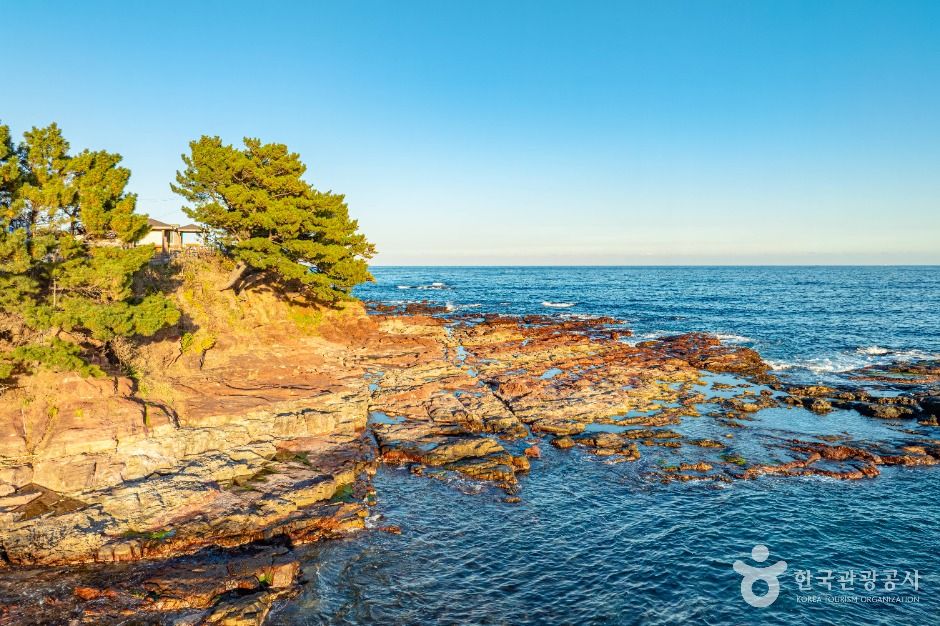
On the coast between Chayu Village and Gyeongjeong Village, mudstone and sandstone from the Cretaceous period, about 100 million years old, form a wave-cut platform, and an uncommon landscape of red mudstone spreading before the East Sea can be seen. On the Chayu Village side, red mudstone is observed, and on the Gyeongjeong Village side, red mudstone and white sandstone spread together. The fact that the wave-cut platform, usually formed in shallow seas, is above sea level indicates that the land in the East Coast region has risen.
The flat spread of red mudstone and white sandstone is because the grains of these rocks were deposited flat. On the coast of Chayu Village to the north, traces of past rivers and traces of clams burrowing into the rock appear. In the sandstone layer distributed on the coast of Gyeongjeong Village to the south, there is graded bedding where the size of sand grains forming the sandstone gradually decreases upward, and in the limestone fragments contained in the sandstone layer, parts of past living organisms can be found. * Wave-cut platform: A flat surface formed on the seabed by wave erosion * Mudstone: Rock formed by the accumulation of mud smaller than 1/16 mm * Sandstone: Rock formed by the accumulation of sand 1/16-2 mm in size
OTA-ready stop
Built into inbound routes and day-tour planning.
Local context
경상북도 영덕군 축산면 경정리
Travel fit
Attraction · Gyeongsangbuk-do
![[Early bird] Elysian Gangchon Ski Tour from Seoul (5 pick-up points)](/_next/image?url=https%3A%2F%2Fadmin.holidaykr.com%2Fapi%2Fadmin%2Fsystem%2Fbasic-settings%2Ffavicon%3Fpath%3D%252Fuploads%252Fproducts%252Fthumbs%252F750_1785201339504_file1.jpg&w=3840&q=75)