Destination briefing
Why travelers stop here
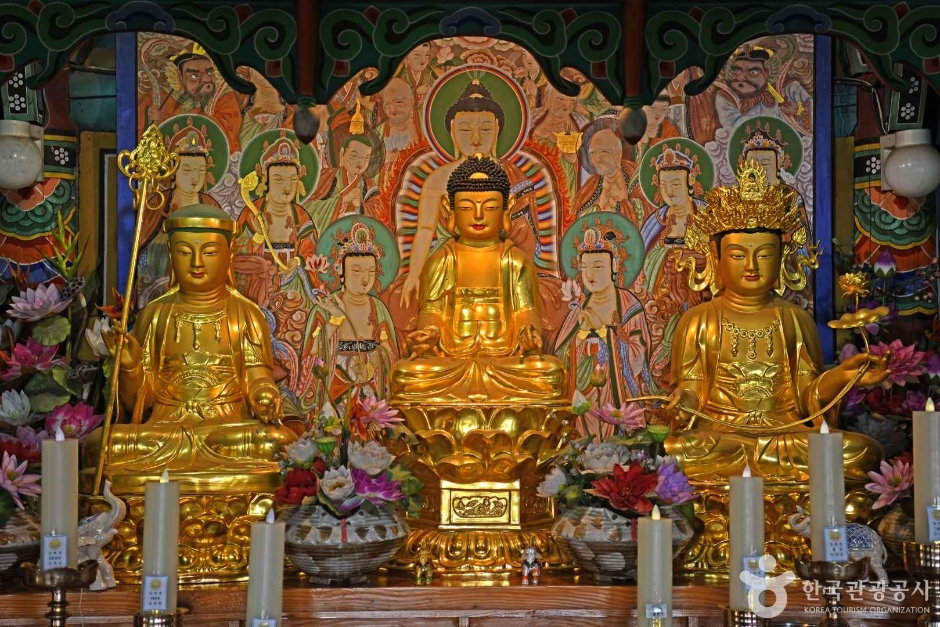
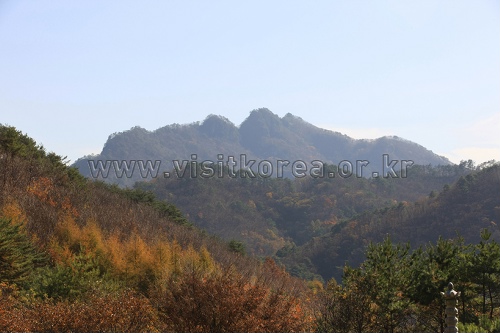
Baengnyeonsa Temple is a branch temple of Beopjusa Temple, the head temple of the 5th district of the Jogye Order of Korean Buddhism, located on Gamaksan Mountain in Bongyang-eup, Jecheon-si, Chungcheongbuk-do. It was founded as Baengnyeonam Hermitage by the Silla monk Uisang during the Three Kingdoms period, and underwent several repairs and reconstructions during the Goryeo and Joseon dynasties. In 1910, the abbot Yun In-seon moved it to its current location inside the mountain fortress and renamed it Baengnyeonsa Temple. Existing buildings include Daeungjeon Hall, Gangdang Hall, Samseonggak Shrine, and Yosachae (monks' quarters). The temple grounds were created by building high stone retaining walls on a steep slope; passing through Boeungmun Gate, which serves as both the one-pillar gate and the monks' quarters, one enters the courtyard centered on Geungnakjeon Hall. In the courtyard, a five-story stone pagoda and a stone lantern stand at the center, with Daeungjeon Hall facing south, flanked by the abbot's residence Muyeomdang and Boeungmun Gate arranged in a ㄷ-shaped structure. Additionally, Samseonggak Shrine is located on a hill outside Boeungmun Gate, and behind Muyeomdang are the lay practitioners' quarters and the kitchen. Daeungjeon Hall is a five-bay front, two-bay side building with a hip-and-gable roof, rebuilt in 1979. Inside, it enshrines a seated Sakyamuni Buddha statue, with a Yeongsanhoesangdo (painting of the assembly on Vulture Peak) as a hanging painting behind the statue. The Buddha statue is a wooden artifact from the Joseon dynasty, 75 cm in height and 45 cm in shoulder width. Additionally, there are a Sinjungtaenghwa (painting of divine beings) and four wall paintings depicting arhats. Samseonggak Shrine is a three-bay front, two-bay side building with a gable roof, built in 1962. To the south of the retaining wall is a wide valley, said to have been a lotus pond, now a wetland area with tall reeds forming a forest. Within the temple grounds, roof tiles, earthenware fragments, and white porcelain fragments from the Joseon dynasty have been collected. The temple complex meets a water pavilion with clear medicinal water along a path past the retaining wall; passing through an arched stone gate carved from a natural rock face, one enters the temple entrance. Although it is difficult to climb due to its steep hillside location, it is a temple worth visiting.
OTA-ready stop
Built into inbound routes and day-tour planning.
Local context
충청북도 제천시 봉양읍 명암로5길 414
Travel fit
Attraction · Chungcheongbuk-do
![[Early bird] Elysian Gangchon Ski Tour from Seoul (5 pick-up points)](/_next/image?url=https%3A%2F%2Fadmin.holidaykr.com%2Fapi%2Fadmin%2Fsystem%2Fbasic-settings%2Ffavicon%3Fpath%3D%252Fuploads%252Fproducts%252Fthumbs%252F750_1785201339504_file1.jpg&w=3840&q=75)