Incheon Terminal 1 and 2 and Gimpo from landing to take-off: which airline uses which terminal, the arrival steps, K-ETA, arrival card and Q-CODE, customs allowances, SIM and power, every way into Seoul with times and fares, luggage services and a departure-day timeline. Figures as of 2026-10-11.
Incheon or Gimpo: which airport
Incheon International Airport (ICN) is Korea’s main gateway, about 48 km west of Seoul on Yeongjong Island, with two passenger terminals and the long-haul and low-cost flights of most airlines. It handled about 71 million passengers in 2024 and is the airport almost every overseas visitor uses.
Gimpo International Airport (GMP) is about 15 km west of central Seoul, much closer to the city. It is mainly a domestic airport (including the busy flights to Jeju), plus a short list of international flights to nearby Asian cities, typically Tokyo Haneda, Osaka Kansai, Beijing Capital, Shanghai Hongqiao and Taipei Songshan. It has an international and a domestic terminal.
If you have a choice, Gimpo is faster for a short stay in Seoul, while Incheon is the only option for most intercontinental flights. Ground transport between the two airports is simple: the airport railroad or a nonstop bus takes about 30 to 40 minutes between Incheon Airport Station and Gimpo.
Incheon’s two terminals and who uses which
Terminal 1 opened in 2001 and Terminal 2 on 18 January 2018, and the airline split is a published list (as of 2026-10-11). Terminal 2 handles Korean Air, Asiana Airlines, Jin Air, Air Seoul, Air Busan and Delta Air Lines, and also the SkyTeam partners Air France and KLM. Terminal 1 handles Jeju Air, Eastar Jet, Air Premia, Trinity Airways and Parata Air, plus most other foreign airlines.
Codeshare flights can change the terminal: a flight sold by one airline and operated by another may use the operator’s terminal. The terminal printed on your e-ticket is the one to trust, and it is worth checking again the night before you fly. The two terminals are about 15 to 18 km apart by road, so a wrong terminal can cost you serious time.
To go between the terminals, a shuttle bus runs about every 10 minutes from 05:00 to 23:00 and takes about 15 minutes from Terminal 1 to Terminal 2 and about 18 minutes the other way. The airport railroad is the alternative: the ride takes about 6 minutes and costs 1,050 won (as of 2026-10-11). Gates are numbered 1 to 50 at Terminal 1, 208 to 290 at Terminal 2, and 101 to 132 at the Concourse, which is reached by a 24-hour shuttle train.
Arrival step by step
- If your gate is at the Concourse, you arrive by the shuttle train, which runs 24 hours, to the main terminal; if you arrive at the terminal, you walk in through the boarding gate on the second floor. Follow the signs for arrival or immigration, because they lead through every step below in order.
- Quarantine: if a health questionnaire is required for your route, submit it and pass the quarantine inspection area. Most visitors walk straight through. Immigration: queue in the lane for foreign visitors and have your passport open. Foreigners aged 17 and over have their fingerprints and a face photo taken, so remove sunglasses and hats and do not use your phone at that moment.
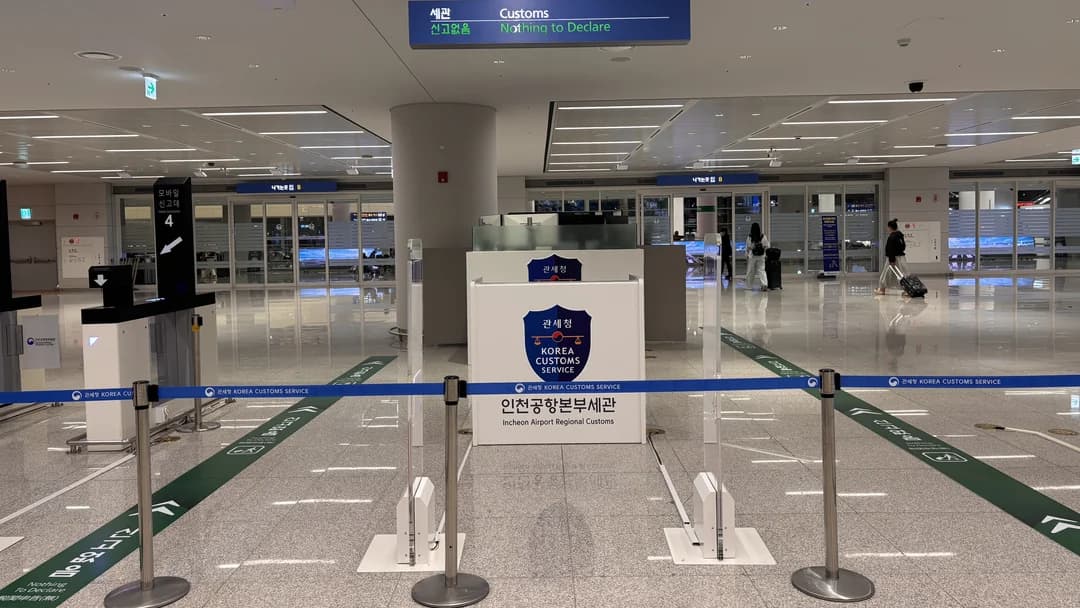
- Baggage claim: check the carousel number for your flight on the screens, take the escalator down to the first floor and collect your bags. If a bag is lost or damaged, report it to the lost baggage desk right behind the claim area before you leave. Customs: if you have nothing to declare, walk through the lane for that; if you do, use the declaration lane.
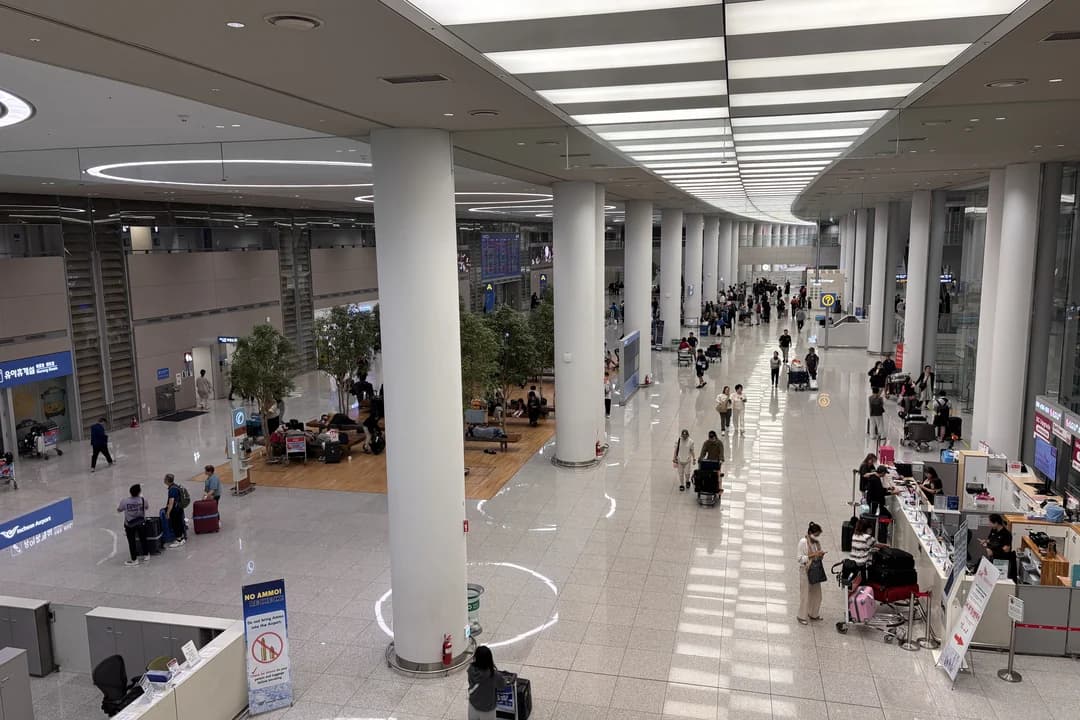
- Arrivals hall: you leave through the departure hall into the arrivals hall, where the exchange counters, telecom counters, tourist information, transit-card shops and the transport signs are. Allow one to two hours between landing and the moment you are ready for onward transport, because immigration and baggage can take that long at busy times.
Entry paperwork: K-ETA, arrival card, Q-CODE
K-ETA is an electronic travel authorization for visitors who can enter Korea without a visa. The fee is 10,000 won, review usually takes within 72 hours, and you should apply well before your flight (as of 2026-10-11). Apply only through the government’s own K-ETA service; look-alike agency sites charge much higher fees. A temporary exemption for many nationalities has been extended to the end of 2026, and exempt travelers may still apply if they want to.
Arrival card: most visitors must submit an arrival card, but holders of a valid residence card, a K-ETA or a group e-visa are exempt (as of 2026-10-11). The electronic version can be submitted up to 3 days before arrival, counted in Korea Standard Time, so for a 31 January arrival the earliest is 29 January. A submitted e-arrival card does not need to be printed or shown at immigration.
Q-CODE is a health declaration required only for travelers arriving from designated quarantine-inspection areas. Where it applies, submit it before arrival and show the QR code on landing; otherwise there is nothing to do (as of 2026-10-11). Reporting health status falsely can lead to a fine under the Quarantine Act.
Have these ready for the immigration officer: a passport that is valid for your whole stay, your return or onward ticket, the address and phone number of your first night’s accommodation (in Korean if possible), and the purpose of your visit. The questions are brief; answer calmly and directly.
Customs and quarantine
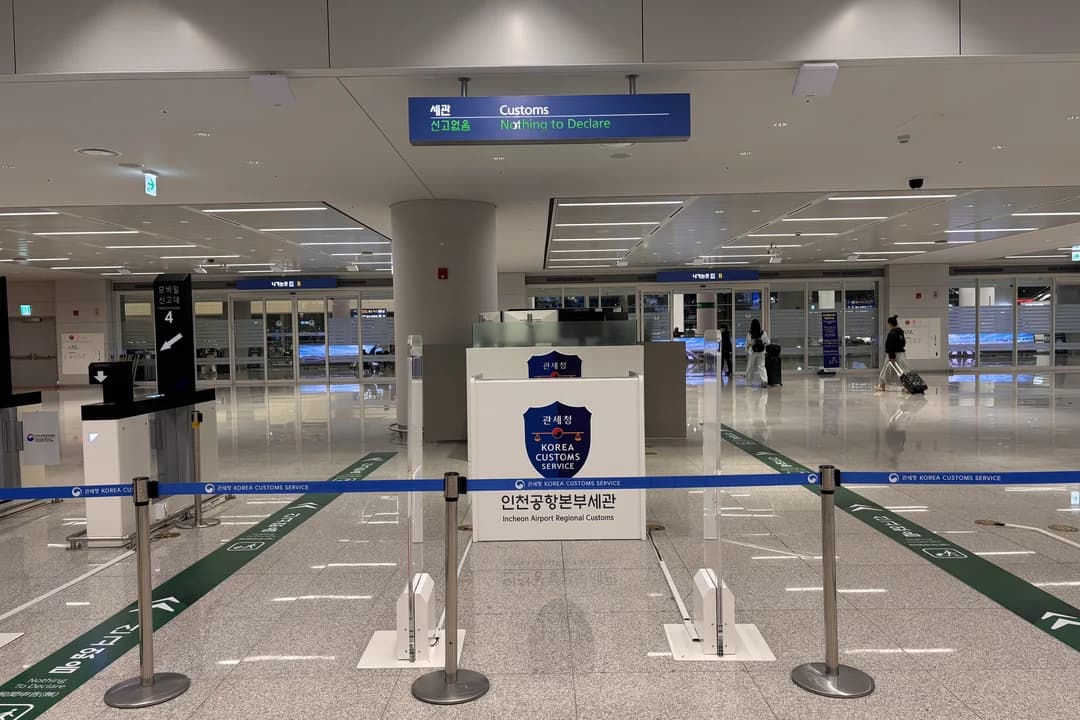
A customs declaration is needed only if you have items to declare; since 1 May 2023 travelers with nothing to declare do not have to fill it in (as of 2026-10-11). One form per family is enough, in Korean or English. You can file it in advance online through the customs app for travelers, which gives you a QR code to scan at the “Goods to Declare” gate; online filing is available at airports nationwide.
Allowances per traveler (as of 2026-10-11): total purchases up to USD 800, alcohol up to USD 400 and no more than 2 bottles and 2 liters, up to 200 cigarettes and up to 100 ml of perfume. Travelers aged 19 or younger do not get the alcohol and tobacco exemption. If you go over, declare the items, because failing to declare is a bigger problem than paying a little duty.
Animal and plant quarantine applies if you carry them: fresh fruit and vegetables, rice straw products and plants with soil are prohibited, and animal products need a quarantine certificate from the exporting country. Meat, dairy, eggs, plants and many foods from home should be left behind or declared. Carry prescription medicine in its original package and keep the prescription with it.
SIM, eSIM, Wi-Fi and power
Free Wi-Fi is available in public areas of major cities, including subway stations, busy bus stops, cafés, restaurants and accommodation, but not every region has reliable coverage. A SIM card is worth considering for the convenience and for places without Wi-Fi: use the SIM for maps and messages, and switch to free Wi-Fi for heavy downloads.
Telecom counters and vending kiosks in the arrivals area sell prepaid SIM cards and rent pocket Wi-Fi devices. An eSIM, which is installed on the phone without a physical card, only works on a phone that supports eSIM and is not locked to your home carrier, so you can buy and install one before you fly. Whichever you choose, set it up before leaving the airport so that you can use maps and transport apps immediately.
Korea uses 220 V power at 60 Hz with two-round-pin plugs, so bring an adapter if your plug is different. The airport has charging points for 110 V, 220 V and USB in the Terminal 1 check-in and departure areas on the third floor, the first-floor arrivals area and the Concourse departure area, so you can top up your phone while you wait.
Money on arrival
Both Incheon terminals have exchange counters and bank branches. Counters keep standard hours of 06:00 to 22:00, and some are open around the clock, while the bank branches run 09:00 to 16:00 on weekdays only (as of 2026-10-11). Gimpo has exchange booths and a Shinhan Bank counter on the first floor of the domestic terminal, to the right of the arrival gate, on weekday hours.
Exchange only what you need for the first day, such as a transit card, a meal and a taxi, because airport rates are not always the best. ATMs that accept foreign cards are in the arrivals area, and cards are accepted in taxis and on airport transport, so you do not need a large amount of cash on landing.
Getting into the city: options at a glance
AREX express: non-stop to Seoul Station in about 43 minutes from Terminal 1 and 51 minutes from Terminal 2, at 13,000 won for an adult booking (as of 2026-10-11). Best when your destination is near Seoul Station or you want a guaranteed seat and no stops.
AREX all-stop: about 59 minutes from Terminal 1 and 66 minutes from Terminal 2 to Seoul Station, at 4,750 won and 5,350 won with a transit card (as of 2026-10-11). It stops at Gimpo Airport, Digital Media City, Hongik University and Gongdeok, so it is best for Hongdae, Mapo and the west of Seoul.
Airport limousine bus: a bus to a major hotel or district without a train transfer, usually 60 to 90 minutes depending on route and traffic. The adult fare on one listed route is 16,000 won and children aged 6 to 13 pay 12,000 won (as of 2026-10-11). Tickets must be bought in advance, because cash and transit cards are not accepted on the Incheon buses.
Taxi: the door-to-door option, most useful for groups of three or four, heavy luggage or a late arrival. Regular taxis charge by the meter and international taxis follow a fare table by section for trips to Seoul. For a first time in Seoul, the trains are the cheapest and most predictable on cost and time, and the bus or taxi is the most comfortable with luggage.
AREX from the airport in detail
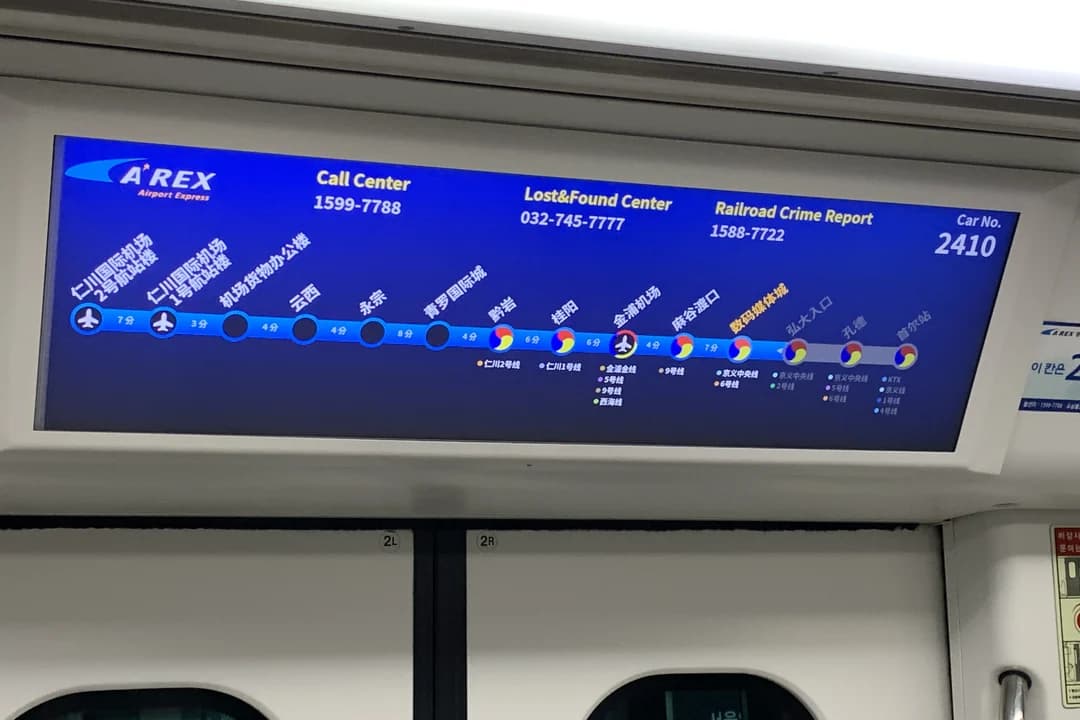
The airport railroad stations are on the basement transportation level (B1) of both terminals. The line runs in this order: Terminal 2, Terminal 1, Airport Cargo Terminal, Unseo, Yeongjong, Cheongna International City, Geomam, Gyeyang, Gimpo Airport, Magoknaru, Digital Media City, Hongik University, Gongdeok and Seoul Station (as of 2026-10-11).
Transfers on the way are useful: Gimpo Airport connects to Lines 5 and 9, the Gimpo Goldline and the Seohae line; Magoknaru to Line 9; Digital Media City to the Gyeongui-Jungang line and Line 6; Hongik University to Line 2 and the Gyeongui-Jungang line; Gongdeok to Lines 5 and 6 and the Gyeongui-Jungang line; Seoul Station to Lines 1 and 4, the Gyeongui-Jungang line and the KTX.
How to ride: the all-stop train takes single-use, prepaid and postpaid transit cards, so tap in like a normal subway. The express needs a ticket from a machine at the station or booked in advance. Choose the express when you are going to Seoul Station and the all-stop when you are going to any station on the way, since the express does not stop between the airport and Seoul Station.
Express bookings can be made up to 60 days ahead and no later than 20 minutes before departure, and must be paid within 20 minutes of booking. The gate opens 30 minutes before departure and you need to be on the platform at least 3 minutes before it leaves. If you miss the train, the next express is not far behind, but check that there is a seat.
Limousine buses and night buses
Where to buy and board: at Terminal 1 the ticket booths are inside the first floor (between Gates 4 and 9, 6 and 7, 8 and 9, and 10 and 11) and outside (between Gates 3 and 4, 7 and 8, and 11 and 12). Seoul buses stop outside exits 3 to 7, Gyeonggi buses outside exits 7 to 10, intercity buses outside exits 11 to 13 and Incheon city buses at exits 2 and 3 and 13 and 14.
At Terminal 2 the staffed ticket office and the ticket machines are on B1 in the Transportation Center, which is also where Seoul buses, Gyeonggi buses and intercity buses leave from; Incheon city buses, group buses and hotel buses leave from the first floor. Look for the route number on your ticket and the board at the stop.
Two route numbers from the operator’s list: 6001 serves Dongdaemun, Myeong-dong, Seoul Station and Sinyongsan, and 6002 serves Dongdaemun, Jongno and Hongdae. Ask the ticket seller which stop is closest to your hotel, because the bus stops at fixed places along each route and does not go door to door.
Night buses: most public transport to central Seoul ends around 23:30, after which night buses with route numbers starting with “N” take over. From the airport, they go to Gangnam Express Bus Terminal, Cheonyangni, Dongdaemun Design Plaza, Gwangnaru and to Goyang, Seongnam, Suwon and Namyangju in Gyeonggi. Tickets have to be bought in advance at the booth or machine.
Taxis from the airport
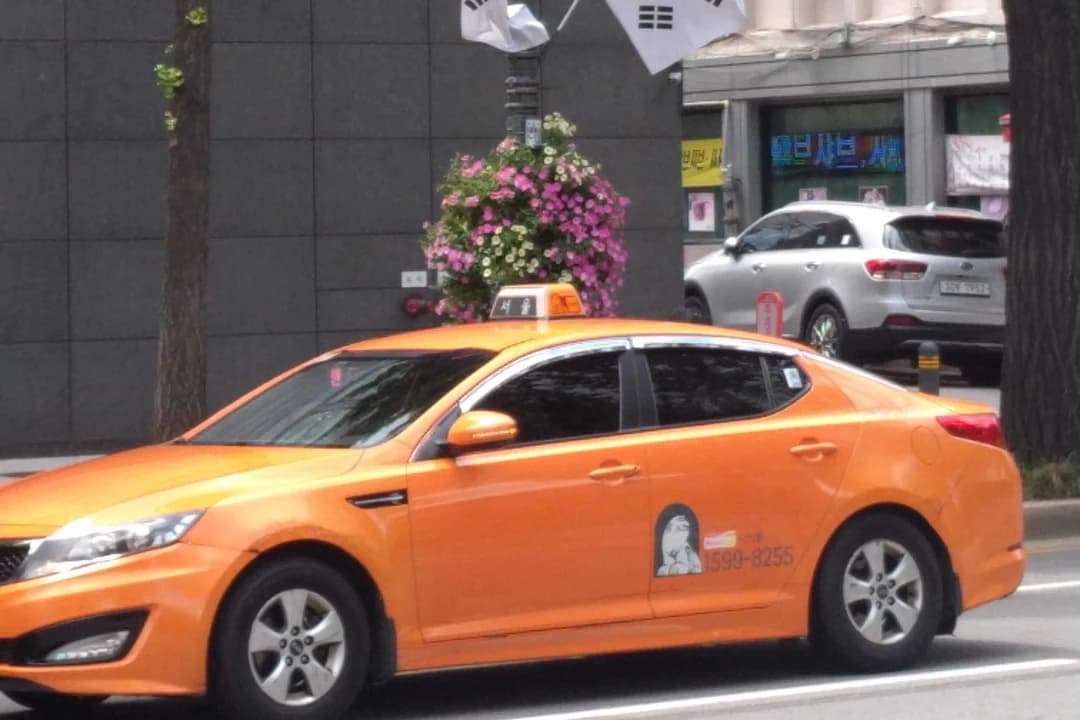
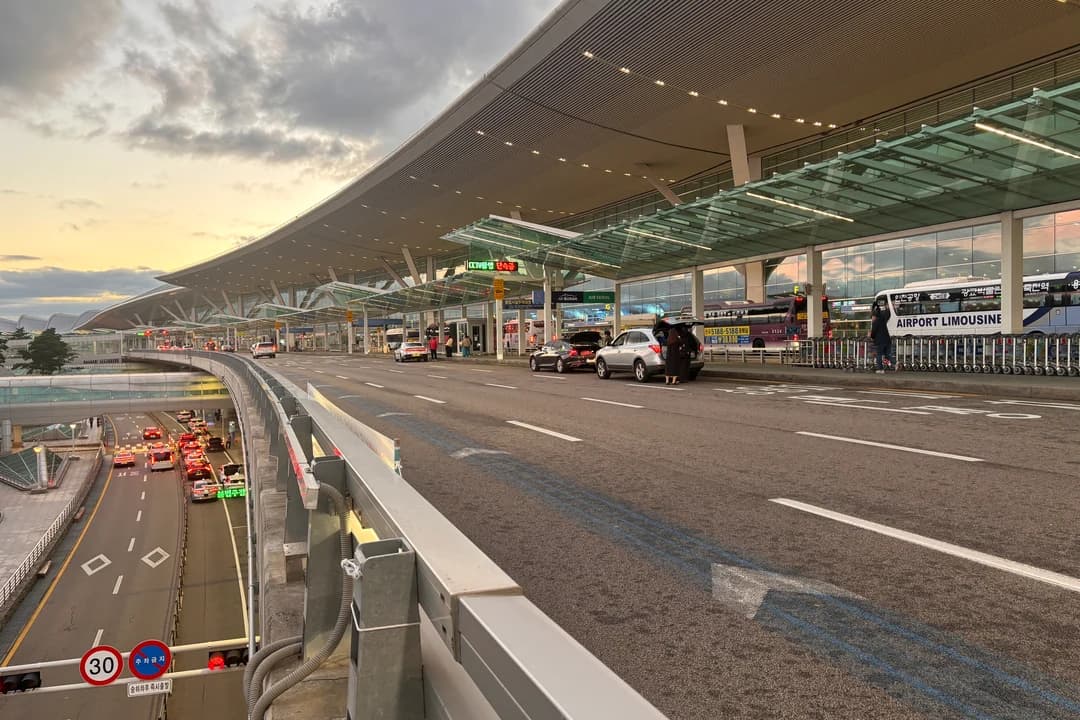
Taxi types: regular taxis (yellow plate and a “TAXI” roof sign), deluxe taxis (usually black, a higher service standard), jumbo taxis for larger groups and international taxis whose drivers speak English, Japanese or Chinese. At both Incheon terminals regular and deluxe taxis wait at the taxi platform outside the arrivals hall, and at Gimpo the stands are at Exit 3 of the international terminal and Exit 6 of the domestic terminal (as of 2026-10-11).
Fares (as of 2026-10-11): the base fare of a regular taxi in Seoul is 4,800 won for the first 2 km, then about 100 won for every 130 to 150 m. A deluxe taxi in Seoul is 6,500 won for up to 3 km, then 200 won for every 151 m. A late-night surcharge applies from 22:00 to 04:00, highest from 23:00 to 02:00, and tolls on the airport bridge and expressways are normally added to the fare.
International taxis must be reserved in advance and trips to Seoul follow a fare table by region. A metered international taxi trip that stays in or leaves Seoul carries a 20 percent surcharge, and out-of-region trips late at night (22:00 to 04:00) can add up to 60 percent. Reservations can be made through the international taxi booking system or at the airport information desk.
Payment is by cash, credit card or transit card. Tipping is not required, because most taxis charge by the meter. Apps help: k.ride, the English, Chinese and Japanese version of Kakao T, accepts overseas credit cards, and Uber Taxi works with your existing Uber payment details; both show a fare estimate before you confirm, and a small call fee may be added.
Gimpo Airport in detail
Gimpo has an international terminal and a domestic terminal. The rail station, Gimpo International Airport, connects AREX (about 23 minutes to Seoul Station), Lines 5 and 9, the Gimpo Goldline and the Seohae line, and reaches central Seoul and the surrounding area in about an hour by these lines (as of 2026-10-11). Line 9 has an express service that is the fastest way to Yeouido and the Express Bus Terminal.
Buses: airport limousine buses leave from the international terminal (exit Gate 1 on the first floor, platforms 6 and 7) and from the domestic terminal (exit Gate 6 for platforms 3, 4 and 5, or exit Gate 4, 5 or 6 for platforms 13, 14 and 15), with the ticket office near Gate 1 on the first floor of the domestic terminal. They accept cash, credit cards and transit cards, and also serve Incheon Airport.
City buses stop more often than limousine buses: platform 4 near Gate 3 at the international terminal and platforms 2 and 6 near Gate 6 at the domestic terminal. Some accept cash for limited destinations, but international credit cards are not accepted, so use a transit card. Taxi stands are at Exit 3 of the international terminal and in front of Exit 6 of the domestic terminal.
The Gimpo tourist information center is at Gate 1 on the first floor of the international terminal, open 10:00 to 19:00, with Korean, Japanese and Chinese help depending on staff schedules. Gimpo and Incheon airports are connected by train or a nonstop bus in about 30 to 40 minutes, so you can leave by the other airport if a connection requires it.
Luggage storage, delivery and porters
Storage counters run by Hanjin Express are at Terminal 1 on the third floor behind check-in counter M and at Terminal 2 on the third floor behind counter H and in the center of the first floor. The listed price is 2,500 won per item per day (as of 2026-10-11). Opening hours differ by counter and by season, with some counters open around the clock, so note the closing time when you drop a bag.
T-Luggage is a same-day luggage delivery between subway stations and the airport. On-site counters at the airport are on the third floor of both terminals, opposite the B and H check-in counters, and the city points are at Seoul Station (B1, between Exits 1 and 2) and Hongik University Station (B1, the airport railroad passage). The service works only for Lines 1 to 9 run by Seoul Metro, and large lockers are required at the station.
Hanjin Express also offers same-day delivery from Hongik University Station to its airport counter, which lets you leave the bags downtown and take the train to the airport with only a carry-on. A paid porter service carries heavy luggage from the third-floor drop-off to the check-in counter on departure, and from the baggage claim on the first floor to the car or bus on arrival, from 07:00 to 19:00.
Departure day: the timeline
- Arrive about 3 hours before an international departure; the airport itself recommends this, because the terminal gets crowded. Check-in counter hours differ by airline, and you can generally check in from about 3 hours before departure. Confirm your terminal on the e-ticket first, and add time if the airline you fly has its counters in the other terminal.
- Order of steps: 1. Arrive on the third-floor departure level of your terminal. 2. If you are claiming a tax refund on goods in your checked bag, see customs first. 3. Check in and drop bags at the counter, self check-in or bag drop. 4. Exchange money, withdraw cash and sort out roaming or insurance before the departure gate, because you cannot come back after immigration. 5. Go through security. 6. Go through departure immigration, either the automated gate or a manned counter.
- After immigration you are in the duty-free zone and cannot return to the pre-security area. Check the gate on your boarding pass: gates 1 to 50 are in Terminal 1, 208 to 290 in Terminal 2 and 101 to 132 at the Concourse, which you reach by the 24-hour shuttle train and cannot walk back from. Arrive at the gate at least 30 to 40 minutes before boarding time.
- A second option is the Seoul Station City Airport Terminal on B2 of Seoul Station, where express-train passengers can check in, drop bags and clear departure immigration for same-day Incheon flights (as of 2026-10-11). Check-in and baggage drop run 05:20 to 19:00 and close 3 hours before departure for Terminal 1 flights and 3 hours 20 minutes before for Terminal 2; immigration runs 05:30 to 19:00.
Tax refund at the airport
If you claim a tax refund, plan the customs stamp before check-in when the goods go into a checked bag (as of 2026-10-11). Terminal 1: customs on the third floor near counters E and J, refund counter near Gate 28 (staffed 07:00 to 22:00). Terminal 2: customs near counters F and G, refund counters near Gates 225, 249 and 274 (staffed 07:30 to 21:30). Unstaffed kiosks at both are open 24 hours.
The conditions in short: you live abroad and stay less than six months, each receipt is at least 15,000 won, the goods are new, unopened and unused, and they leave Korea within three months of purchase (as of 2026-10-11). At the airport there is no purchase limit. Gimpo has its customs on the second floor near Gate 1 and its refund counter on the third floor near Gate 36, staffed 06:30 to 20:00.
Resting, charging, hotels and help
Airside areas have seating, charging points and eating places, and the Concourse has six lounges. Lounge access depends on your ticket class, airline status or card benefits, and those lounges sit in the departure area beyond immigration. Information desks are located at 11 points across Terminal 1, the Concourse and Terminal 2, and the Korea Tourism Organization runs a tourist information center in both Incheon terminals.
For a night near the airport, several hotels run free shuttles, as listed by the airport: Grand Hyatt Incheon is minutes from Terminal 1 and about 20 minutes from Terminal 2 with a free shuttle every 30 minutes, Hotel Queen Incheon Airport is about 7 minutes away with free 24-hour pickup, and Hotel New Airport is about 6 to 10 minutes away with free 24-hour pickup. Best Western is about 2 minutes away with 301 rooms.
Lost property is held at the lost-and-found office of each terminal and unclaimed items are kept for two to three months before they are handed to the police. If you left something on the plane, tell your airline at the baggage desk or the airline counter before you leave the building; items left on the aircraft are handled by the airline, not by the airport.
Transit tours and long layovers
The Transit Tour is a program for passengers with a layover of 24 hours or less, and it goes out of the airport and back in time for the next flight (as of 2026-10-11). Seats are first come, first served, online and on arrival. Register in person with your passport and the boarding passes for both your arriving and departing flights at least 30 minutes before the tour starts, or a reserved seat goes to the waiting list. Admission fees and meals are paid by you.
You must be allowed to enter Korea, which means a valid visa or a K-ETA unless your nationality is on the temporary exemption list; you may not enter Korea twice during one visit. Registration desks: Terminal 1, first floor after immigration near Gates 1 and 2 (desks 19 and 20); Terminal 2, first floor on the landside across from Exit 4 (desks 5 and 6). The program may change without notice.
For stays of 24 to 72 hours there is the K-Stopover program for transit passengers: a hotel stay at one of nine 3 to 5 star hotels in Seoul, Incheon and other regions, airport transport options, tour packages with set prices and schedules, and free airport lounge access. The registration desk is open 07:00 to 18:00, and the refund rules are 100 percent up to 7 days before, 50 percent up to 3 days before, 30 percent up to 2 days before and none on the day.
Without leaving the airport, a long layover goes better if you stay organized: put your bags in storage, charge your phone, find a quiet airside seating area, and never wander so far that you could miss a boarding call. Allow one to two hours for immigration if you plan to leave the airport, and be back well before the check-in or gate deadline of the next flight.
Common mistakes
- Do not go to the wrong terminal. Check the terminal on the e-ticket, and remember that a codeshare can put you in the other terminal, 15 to 18 km away by road. Allow time for the inter-terminal shuttle bus or the 6-minute airport railroad ride before you assume you are in the right place.
- Do not plan a tight connection after landing. Immigration, baggage and customs can take one to two hours at busy times, so do not buy a non-refundable ticket for a bus that leaves soon after landing, and do not book the express train for a time that is too early.
- Do not pack tax-refund goods into your checked bag before customs has stamped the receipts, do not forget that you cannot return after departure immigration, and do not leave money exchange, cash withdrawal and SIM setup until the last minute. Once you are beyond immigration you can only shop and wait.
- Do not rely on the subway or bus for a very early departure, do not arrive at the check-in counter after it has closed, and do not forget that Seoul Station City Airport Terminal only serves express-train passengers on the same day. Keep a margin of at least the three hours the airport recommends.
Sources and last update
Last updated: 11 October 2026. Figures are as of the date shown.
Source: Incheon International Airport Corporation · Korea Tourism Organization · Incheon Airport Railroad · Korea Customs Service · Ministry of Justice, K-ETA · Korea Disease Control and Prevention Agency · Checked 11 Oct 2026
Written by HOLIDAY in its own words from official public information. This is not an official publication of the Korea Tourism Organization or any government body.
HOLIDAY refreshes this article regularly as fares, hours and event dates change.