Everything before and after landing in one place: who needs K-ETA and how it works, the 2026 temporary exemption, the free e-Arrival Card, when Q-CODE applies, immigration and customs steps, duty-free limits and what to say. Figures are as of 2026-10-11.
At a glance (as of 2026-10-11)
Three separate things can apply to you: a K-ETA travel authorization (for visa-free nationalities, unless exempt), the free e-Arrival Card (for everyone without a K-ETA), and a Q-CODE health entry (only for travelers from listed areas). They are different systems (as of 2026-10-11).
A temporary exemption lets travelers from 22 listed countries and territories enter without K-ETA from 2026-01-01 to 2026-12-31 (Korea time). If you are exempt you still file the e-Arrival Card (as of 2026-10-11).
Short-term visits are stays of less than 90 days; the exact permitted stay depends on your nationality. See the Visa guide for the list (as of 2026-10-11).
On arrival the order is: quarantine desk (only if Q-CODE applies), immigration (photo, fingerprints and a few questions), baggage claim, customs. This guide covers each step.
Checklist before you fly
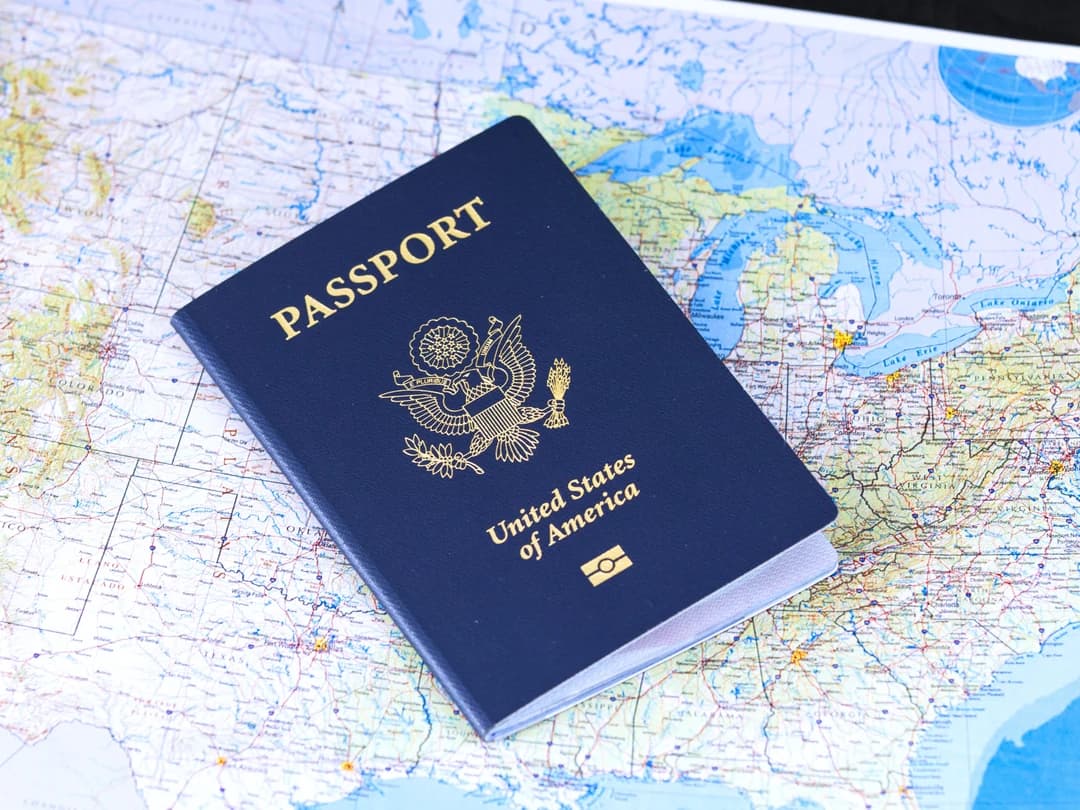
- Make sure your passport is in good condition and has not expired. Korean immigration refuses entry to people whose passport is expired, and the airline will check it at the desk too.
- Work out which case you are in: you need a visa, you can enter visa-free and need K-ETA, or your nationality is on the 2026 temporary exemption list. Each case is explained in the sections below.
- If you need K-ETA, apply at least several days before departure. Review generally takes within 72 hours, but it is a typical time, not a guarantee (as of 2026-10-11).
- If you have no K-ETA, plan to file the free e-Arrival Card in the three days before you land (it cannot be filed earlier). Details are in the e-Arrival Card section.
- Prepare your return or onward ticket, the Korean-language address of your first night, and a phone number. These are what the immigration officer typically asks about.
- Save offline copies of your passport page, bookings and insurance details, and keep them apart from the originals. If you were in a Q-CODE area, complete it up to 7 days before landing.
K-ETA: what it is and who needs it
K-ETA (Korea Electronic Travel Authorization) is an online pre-approval for people who may enter Korea without a visa. You apply before the trip and the approval is tied to your passport.
It applies to nationalities that can enter visa-free. If your nationality needs a visa, you apply for a visa instead and K-ETA is not the right route.
K-ETA is not a visa and does not guarantee entry: the officer at the immigration counter makes the final decision when you arrive.
A valid K-ETA also replaces the separate arrival card, so holders do not file the e-Arrival Card for that trip.
Only the genuine K-ETA mobile app and its own application portal accept applications. Look-alike sites charge high agent fees. The K-ETA center generally does not take phone calls or walk-ins; questions go through the inquiry form inside the application.
K-ETA: fee, review time and validity (as of 2026-10-11)
Fee: 10,000 won per application, roughly 7 to 8 US dollars (as of 2026-10-11). Once an approval has been issued the fee is not refunded.
Review time: generally within 72 hours, as published (as of 2026-10-11). It is a typical time, not a promise, so avoid applying on the day of the flight.
Validity: an approval is reported to last up to three years from approval, valid for multiple trips, and not longer than your passport (as of 2026-10-11). Older material still says two years.
The approval is linked to the passport you applied with. If you get a new passport, expect to apply again with the new passport number.
The application asks for a facial photo upload along with passport details. A K-ETA issued earlier stays valid until its own expiry date even if your nationality later becomes exempt.
K-ETA: how to apply, step by step
- Open the genuine K-ETA mobile app or its own application portal. Do not use any other site, even if it ranks first in search results.
- Agree to the terms, then either create a member account or, if you prefer not to register, verify your email address and continue as a non-member.
- Enter your passport information. Scanning a photo of the passport information page fills most fields, and the nationality you choose also tells you whether you are on the temporary exemption list.
- Fill in the application details (personal and travel information, contact and stay address) and upload the facial photo.
- Review everything carefully; names and numbers must match the passport exactly. Then pay the 10,000 won fee online (as of 2026-10-11).
- Wait for the result, generally within 72 hours (as of 2026-10-11). Members see the result in their account; non-members use the verified email. Keep the approval on your phone.
The 2026 temporary K-ETA exemption
The Ministry of Justice extended the temporary exemption by one year in a notice dated 2025-12-29. It runs from 2026-01-01 to 2026-12-31, Korea time, to support tourism (as of 2026-10-11).
The notice does not print the list. The 22 countries and territories widely reported are: Hong Kong, Japan, Macao, Singapore, Taiwan; Australia, New Zealand; the United States (including Guam) and Canada (as of 2026-10-11).
Continued: United Kingdom, France, Germany, Italy, Netherlands, Norway, Poland, Spain, Sweden, Austria, Belgium, Denmark and Finland. Mainland China is not on this list (as of 2026-10-11).
In the K-ETA application, choosing your nationality shows an exemption message if you qualify. Exempt travelers may still apply on a voluntary basis, which also spares them the arrival card, but the fee is charged (as of 2026-10-11).
Exempt does not mean no paperwork: unless you hold a K-ETA, you must still file the free e-Arrival Card for the entry (as of 2026-10-11).
What happens after 2026-12-31: no further extension had been announced as of 2026-10-11. If you land in 2027, plan on needing K-ETA unless a new extension appears. K-ETAs already issued stay valid until their own expiry.
e-Arrival Card (free, as of 2026-10-11)
The e-Arrival Card is the online entry declaration that replaces the paper arrival card for foreign visitors. The Ministry of Justice announced it on 2025-02-24, paper cards were still accepted during the 2025 transition, and it is the standard form in 2026 (as of 2026-10-11).
Who files: all foreign visitors without a valid K-ETA. Not required: holders of a valid K-ETA, foreign residents who completed residence registration (including permanent residents), group e-visa travelers, crew, and certain group tourists and transit passengers (as of 2026-10-11).
When: you can file from 3 days before arrival (Korea time) up to the immigration inspection. It stops being valid 72 hours after submission and once you pass immigration, so a new entry needs a new card (as of 2026-10-11).
What you need: a valid passport, an email address, your entry date and flight number, the place you will stay, and your departure date. The departure flight number is optional (as of 2026-10-11).
After submitting, an issuance number arrives by email and a QR code can be saved. You do not have to carry a printout, but keep the number on your phone because it helps at the counter.
Before the inspection you can still edit the purpose of entry, the stay details and the departure date. The arrival date can only be corrected within 3 days of the first submission (as of 2026-10-11).
A group tool exists for tour leaders: up to 1,000 people at once on a computer, but only 9 at once from a phone browser (as of 2026-10-11). It is a separate system from K-ETA and is free; a fake-site warning was issued on 2026-03-09, so never pay anyone to file it.
Q-CODE: is it still required? (as of 2026-10-11)
Q-CODE is the Korea Disease Control and Prevention Agency (KDCA) health entry system: you enter your details on a phone, computer or tablet, receive a QR code and show it to the quarantine officer. It started as a pandemic-era tool.
It is still in use. The KDCA guide for the fourth quarter of 2026 lists the areas as of 2026-10-01, so Q-CODE has not been abolished. It applies only to travelers from listed areas, not to every arrival (as of 2026-10-11).
Strict areas (plague, zoonotic influenza, MERS, Nipah virus, Ebola): everyone who stayed in or passed through must submit a Q-CODE or the paper Health Declaration Form. Ordinary quarantine areas: only travelers with symptoms such as fever or cough (as of 2026-10-11).
Strict areas as of 2026-10-01, Asia: Mongolia, Bangladesh, India, Cambodia and China (only Guangdong, Guangxi, Sichuan, Anhui, Yunnan, Jiangxi, Jiangsu, Tianjin, Hunan, Hubei). Americas: Brazil and the US states of New Mexico, Michigan and Washington.
Strict areas, Middle East: Lebanon, Bahrain, Saudi Arabia, Syria, United Arab Emirates, Yemen, Oman, Jordan, Iraq, Iran, Israel, Qatar, Kuwait. Africa: South Sudan, Rwanda, Madagascar, Burundi, Angola, Ethiopia, Uganda, Zambia, Central African Republic, Republic of the Congo, DR Congo, Tanzania (as of 2026-10-01).
The ordinary list is long (dozens of countries on every continent, including Japan, China, Taiwan, Hong Kong, Singapore, Thailand, the Philippines, Germany, Spain, the UK, Australia, Canada and the US), so if you arrive with fever or cough after any recent trip, enter a Q-CODE (as of 2026-10-01).
Timing: Q-CODE can be entered from 7 days before arrival until before you pass entry. Pre-registering saves time; if you did not, a kiosk or tablet at the quarantine area lets you obtain a code on the spot (as of 2026-10-11).
Not reporting your health status, or reporting it falsely, can lead to a fine of up to 10 million won under the Quarantine Act (as of 2026-10-11). The area and disease lists are updated each quarter, so earlier 2026 lists were different.
After landing, step by step
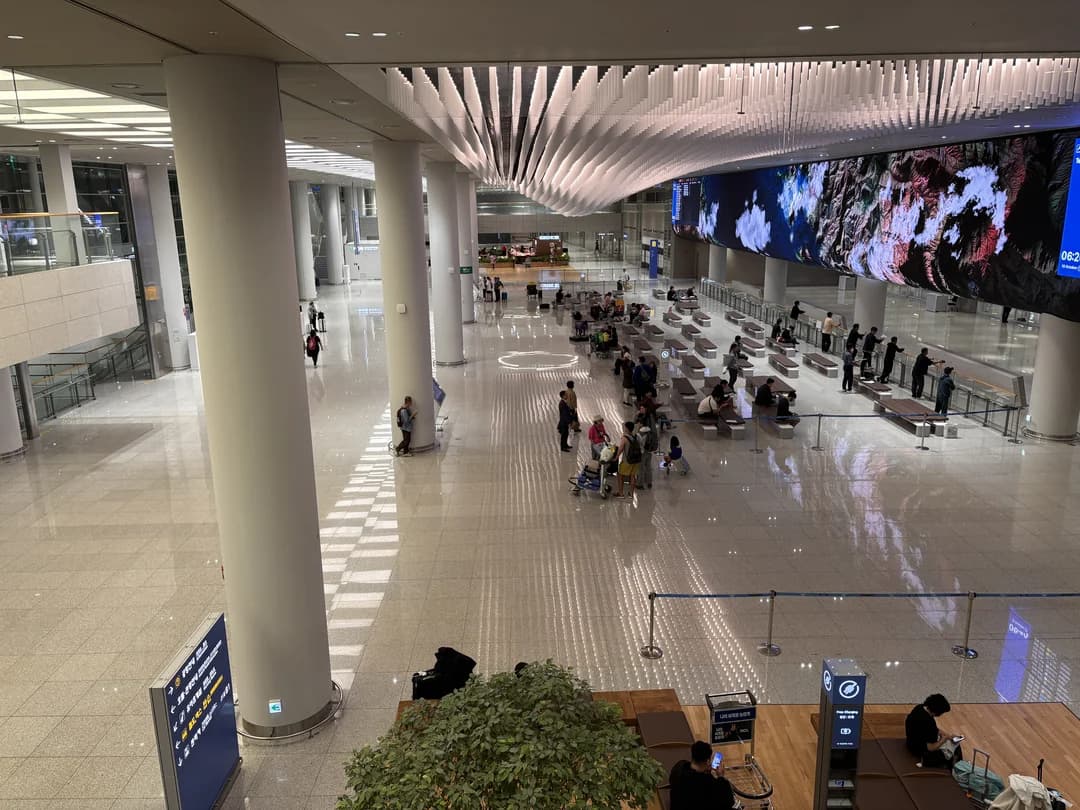
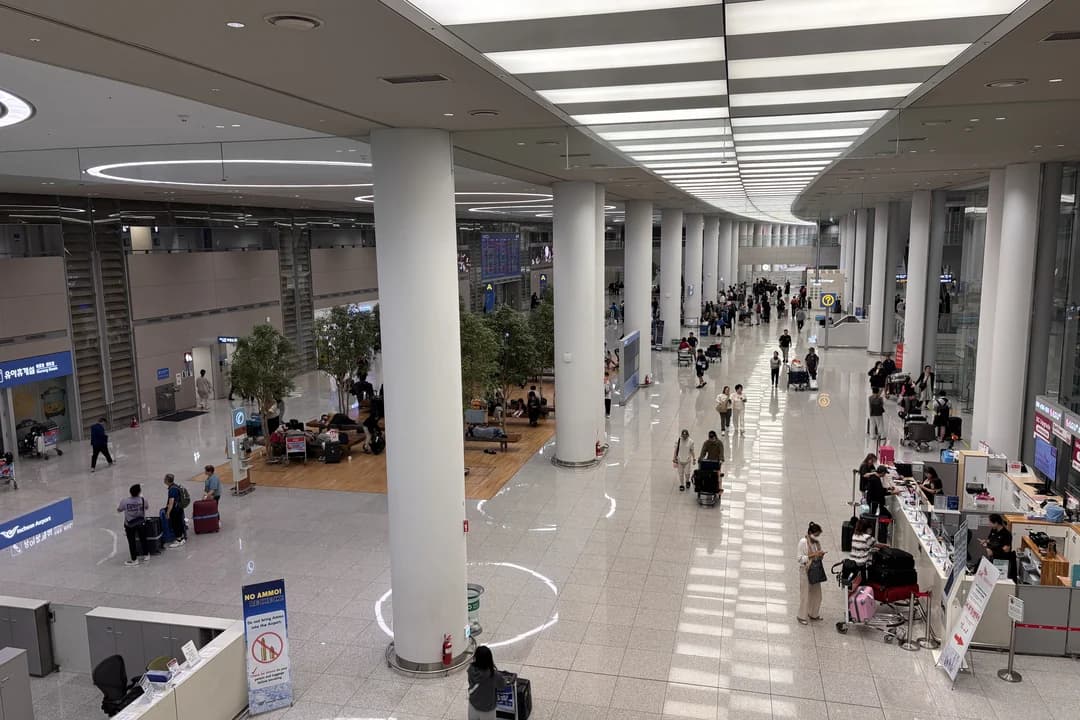
- Follow the arrivals signs. At Incheon, if your flight arrives at the separate concourse, a shuttle train to the main terminal runs around the clock (as of 2026-10-11).
- If Q-CODE applies to you, go to the quarantine desk and show your QR code, or complete the health entry on the spot.
- At immigration, queue in the lane for foreign visitors and hand over your passport. Foreign visitors usually have a photo taken and fingerprints scanned; remove a mask or glasses if asked, and give short answers about why you came, how long you will stay and where.
- Collect your bags at the carousel shown for your flight. At Incheon, take the escalator down to the first floor to find the baggage claim; missing or damaged bags are reported at the lost-baggage counters there.
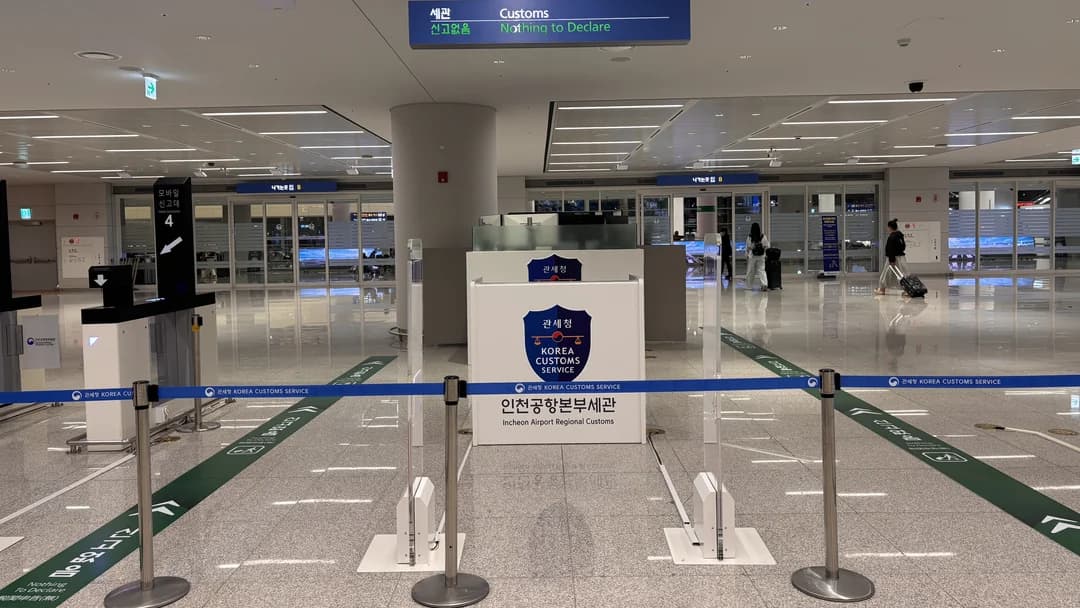
- At customs, hand in your declaration and use the route that fits: nothing to declare, or goods to declare. If you are unsure, declare. The customs sections below list the exact limits.
- In the arrivals hall, the tourist information desks at Incheon are open 07:00 to 22:00 all year (as of 2026-10-11): Terminal 1 east wing near exit 5, west wing near exit 10, and Terminal 2 opposite exit 3. Phone +82-32-743-2600; staff speak Korean, English, Japanese and Chinese.
What to say at immigration and customs
Purpose of visit: “I am here for sightseeing.” In Korean, 관광하러 왔어요 (gwangwanghareo wasseoyo). For a business or medical trip, say it plainly in English or show the document.
Length of stay: “I will stay five days.” 5일 동안 있을 거예요 (o-il dongan isseul geoyeyo). Say the number of days that matches your return ticket.
Where you stay: show the hotel booking or the Korean-language address on your phone. “This is my hotel.” 제 호텔이에요 (je hoteli-eyo).
Return ticket: “Here is my return ticket.” 돌아가는 비행기표예요 (doraganeun bihaenggipyoyeyo). Keep it on your phone, ready to open.
At customs: “I have nothing to declare.” 신고할 물건이 없어요 (singohal mulgeoni eopseoyo). “I have something to declare.” 신고할 물건이 있어요 (singohal mulgeoni isseoyo).
If you do not understand a question: “English, please.” 영어로 해 주세요 (yeongeoro hae juseyo). Ask for an interpreter with 통역이 필요해요 (tongyeogi piryohaeyo). Stay calm and polite; short, true answers are enough.
Customs: duty-free limits (as of 2026-10-11)
Duty-free allowance: goods with a total taxable value of up to US$800 (as of 2026-10-11). Agricultural, livestock and fishery products are limited to 5 kg per item, 40 kg in total and 100,000 won of overseas purchase price.
Extra allowances on top: liquor up to 2 liters in total and US$400 in value; 200 cigarettes; 20 ml of e-cigarette liquid with nicotine below 1%; perfume up to 100 ml (as of 2026-10-11).
Visitors under 19 (counted by birth year) get no liquor or tobacco allowance at all (as of 2026-10-11).
Going over the limit: declare it. A voluntary declaration cuts the customs duty by 30%; if undeclared goods are found an extra 40% is added, rising to 60% for repeat cases within 2 years (as of 2026-10-11).
The declaration can be submitted on paper or on a mobile phone, and a voluntary mobile declaration lets you receive the payment notice on your phone too (as of 2026-10-11).
Customs: what must be declared, cash and medicine
Always declare: goods above the allowance, commercial goods, repair items and samples; firearms, explosives, stun guns and crossbows; foods, plants and animal products; protected species and products made from them; items that infringe intellectual property (as of 2026-10-11).
Cash and equivalents: up to US$10,000 in total needs no declaration. Above that, tick yes on item 3 of the declaration form, write the amount and obtain a certificate; it cannot be issued after you have passed immigration (as of 2026-10-11).
Not reporting cash above the limit can bring up to 1 year in prison or a fine of up to 100 million won, or up to triple the value if that is higher (as of 2026-10-11).
Medicines: drugs and medicines that can be misused must be declared. Carry prescription medicine in its original package with the prescription or a doctor’s letter, and bring only what you need for the trip.
Food and plants: meat, fruit, vegetables, dairy, live seafood and other agricultural products are controlled. Do not bring them without declaring; confiscation at the border is the usual result if they are not allowed.
Prohibited outright: sexually explicit materials and forged currency or securities. Leaving Korea with more than US$10,000 also needs a report, and what is required depends on the purpose (as of 2026-10-11).
Do
- Do apply for K-ETA, if you need it, through the genuine app or its own portal and well before departure.
- Do file the e-Arrival Card inside the 3-day window if you have no K-ETA, and keep the issuance number on your phone (as of 2026-10-11).
- Do carry your passport in Korea; you may be asked for ID, and a photo of the passport page on your phone is a useful backup.
- Do declare when in doubt: declaring something that turns out to be allowed costs nothing, while not declaring can cost a lot.
Avoid
- Do not use look-alike K-ETA, e-Arrival Card or Q-CODE sites, and do not pay anyone who offers to “speed up” or “guarantee” a government form.
- Do not apply for K-ETA on the day of the flight, and do not book non-refundable travel before you know which route applies to you.
- Do not photograph immigration booths or officers, and do not leave luggage unattended in the arrivals area.
- Do not carry food, plants or unexplained medicines in your bag without declaring them, and do not give false answers on the declaration form.
Quick answers and a note on changing rules
I am exempt from K-ETA. Do I do nothing? No: file the free e-Arrival Card in the 3 days before landing, unless you chose to hold a K-ETA (as of 2026-10-11).
I forgot to file the e-Arrival Card. Can I still do it? It can be filed up to the immigration inspection, so do it on your phone as soon as you land, before the queue.
I have a K-ETA that was issued years ago. A K-ETA issued earlier stays valid until its own expiry, as long as the passport is the same one you applied with.
Does Q-CODE apply because I flew through a listed airport? Yes for strict areas, which include transit; for ordinary areas only if you have symptoms (as of 2026-10-11).
Where do I turn for immigration questions in Korea? The immigration contact center, 1345, answers on weekdays 09:00 to 22:00 except public holidays (as of 2026-10-11). See the Visa guide for details.
Entry rules can change at short notice, for example the exemption list, the Q-CODE areas and the form details. This guide is refreshed regularly and was last updated on 2026-10-11.
Sources and last update
Last updated: 11 October 2026. Figures are as of the date shown.
Source: Ministry of Justice, K-ETA · Korea Disease Control and Prevention Agency · HiKorea · Incheon International Airport Corporation · Checked 11 Oct 2026
Written by HOLIDAY in its own words from official public information. This is not an official publication of the Korea Tourism Organization or any government body.
HOLIDAY refreshes this article regularly as fares, hours and event dates change.