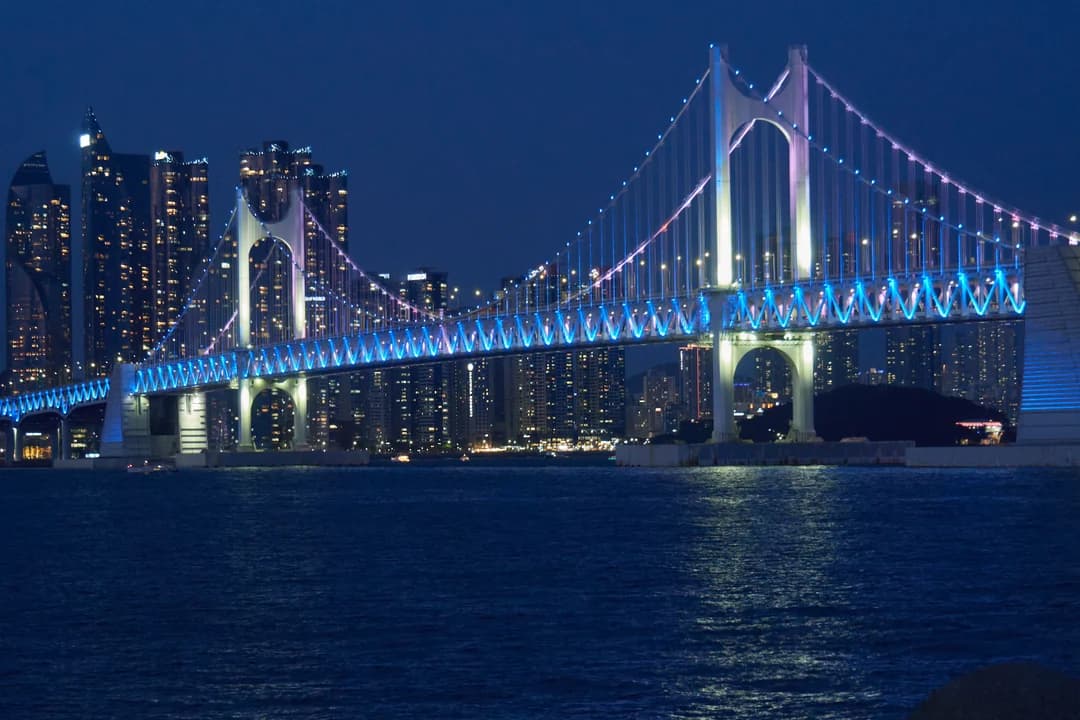
Haeundae, Gwangalli, Nampo, Gamcheon, Taejongdae and more: metro fares, tour bus and pass, opening hours, October 2026 festivals, food and 3- and 5-day routes, dated as of 2026-10-11.
Overview: how Busan is laid out
Busan is South Korea's second-largest city and its main port, strung along the southeast coast between mountains and sea. Beaches, fish markets, hillside villages, temples and cliff parks all lie inside the city limits, so a single trip can cover a surf beach, a film festival, a 1,300-year-old temple and a wartime refugee neighborhood.
Think of five zones. Haeundae in the east has the best-known beach, Centum City and most luxury hotels. Suyeong (Gwangalli) faces the lit-up Gwangan Bridge. Central Busan, around Nampo, Jagalchi, Seomyeon and Busan Station, is the historic core and the main transit hub. The north holds Beomeosa temple and Geumjeongsan mountain. The west includes Gimhae airport, Gamcheon Culture Village and the Nakdong river delta. Yeongdo island in the south is home to Taejongdae.
The city's public transit, tour bus and tourist pass are covered below, and the sights are described in the order a traveler meets them. Most visitors need 3 days for the highlights and 5 days to add Gijang, Dongnae and the evening shows. Many museums close on Mondays, so build your week around that.
Best time to go
Busan is mild by Korean standards. Typical monthly average temperatures (rounded long-term averages) are about 4 °C in January, 14 °C in April, 26 °C in August and 18 °C in October. Spring and autumn are the best months for walking the coastal trails and hillside villages, summer is beach season and humid, and winter is cold but seldom snowy.
October is the busiest cultural month. The Busan International Film Festival runs 6 to 15 October 2026, and the city's own Festival Shiwol program lists dozens of events through the month (see the festivals section); November brings the fireworks festival at Gwangalli. Book hotels early for both (as of 2026-10-11).
Sea attractions run on weather rules: the Songdo cable car, the Oryukdo Skywalk and the Taejongdae train can all stop or shorten in strong wind, rain or snow. Keep an indoor alternative (a museum, the aquarium, a department store) for every day.
Getting there: KTX, airport and ferries
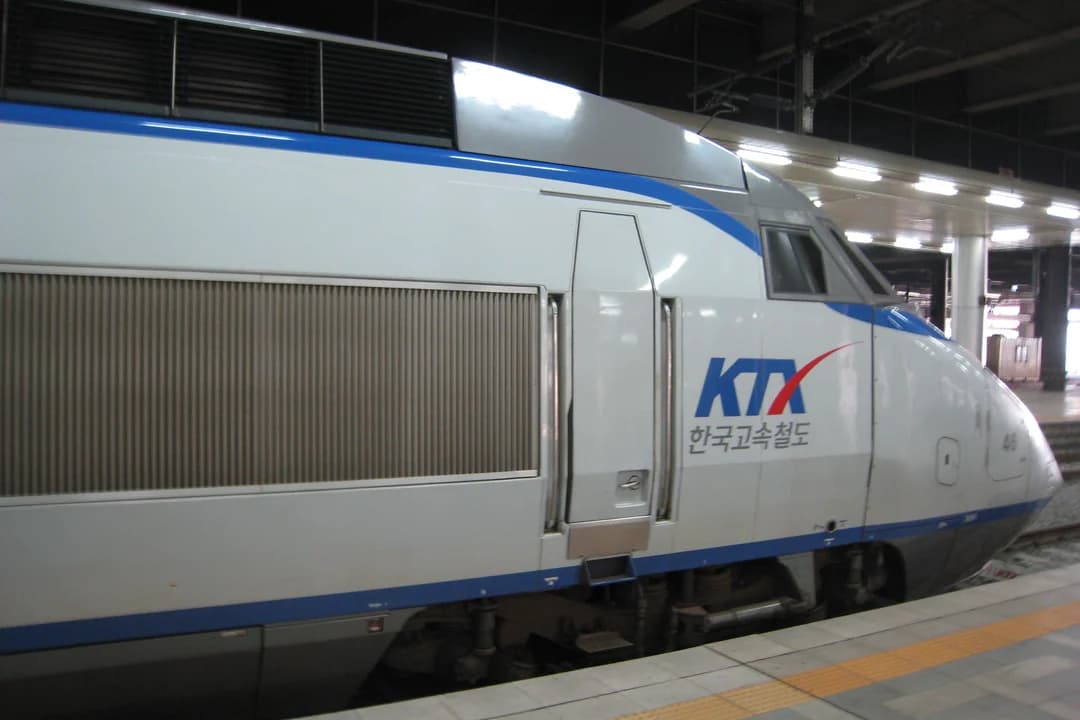
The Gyeongbu high-speed line (447.1 km) connects Seoul and Busan and is Korea's busiest rail route. The KTX from Seoul Station takes roughly 2 to 2.5 hours depending on the train (the fastest services are a little over 2 hours), and ends at Busan Station in the old center. SRT trains leave from Suseo Station in Seoul. Korail tickets go on sale one month ahead at 07:00 and can be bought up to about 20 minutes before departure (as of 2026-10-11).
Gimhae International Airport is on the Busan-Gimhae Light Rail (BGL), which runs from Gaya University to Sasang (22.4 km, 21 stations, 37 minutes end to end) from 05:00 to 24:00, every 3.9 minutes at peak, about every 6 minutes by day and every 10 minutes at night and early morning (as of 2026-10-11). Change at Sasang to metro Line 2 for Seomyeon and Haeundae. A BGL ride with a transit card costs ₩1,300 for adults (₩1,500 for the outer section), and a change between metro and BGL within 30 minutes is charged a ₩500 transfer fare for adults (as of 2026-10-11).
Currency exchange is available at Gimhae Airport in the departure hall (Busan Bank, 2nd floor, 06:00 to 21:00 daily) and at the Busan Port International Passenger Terminal for ferry arrivals (2nd floor, 07:40 to 19:40, subject to vessel schedules) (as of 2026-10-11). Bring your passport. Jeju is about an hour by air; the car-ferry to Jeju stopped in 2024. International ferries to Japan use the Busan Port International Passenger Terminal in Dong-gu, close to Busan Station.
Getting around: metro, buses and cards
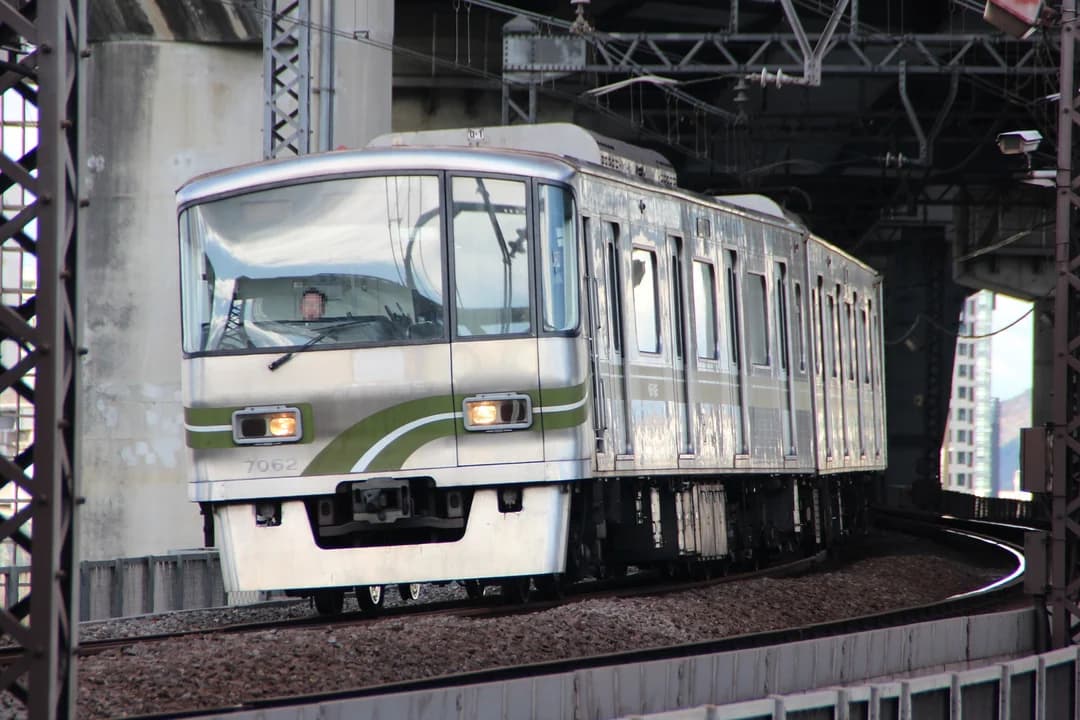
The Busan Metro has four lines, plus the Donghae Line (to Haeundae and Songjeong) and the BGL light rail. Lines 1 and 2 cross at Seomyeon. With a transit card or mobile ticket, an adult single trip in the first fare section costs ₩1,600 and ₩1,800 in the second section; a one-way QR ticket is ₩1,700 or ₩1,900. A 1-day pass on the Busan Metro app is ₩6,000 for adults and a 3-day pass ₩13,000 (as of 2026-10-11).
Transfers between metro, BGL, city bus and village bus are discounted when you tap in within 30 minutes of getting off, up to twice (three rides in total) per journey, with a transfer fare of ₩500 for adults, using cards such as mybi, Hanaro or the major credit cards (as of 2026-10-11). Buses in the hillside areas, such as the village buses to Gamcheon, are small and frequent.
Taxis are metered. Some taxis near the port have been reported to quote fixed fares far above the meter, so insist on the meter. The metro is best for Haeundae, Gwangalli (Gwangan Station, Line 2), Seomyeon and Nampo; use buses only for places the metro does not reach, such as Taejongdae, Huinnyeoul and Gijang.
Busan City Tour Bus and the Visit Busan Pass
The Busan City Tour runs hop-on, hop-off loops from Busan Station: the Red Line to Haeundae and back, the Green Line along the south coast to Oryukdo and Songdo, and the Orange Line to Dadaepo and Eulsukdo; the Blue Line to Haedong Yonggungsa is suspended. One day pass for all three loops is ₩20,000 for adults and ₩10,000 for children aged 48 months to 13. The service is closed on Mondays and Tuesdays (as of 2026-10-11).
The Red Line makes nine runs from Busan Station on Wednesday to Sunday, every 50 minutes, the first at 09:45 and the last at 16:35; stops include the UN Memorial Cemetery, Busan Museum, Gwangalli, Dongbaekseom, Haeundae Beach, Centum City (Busan Cinema Center), BEXCO and Gwangbok-ro (as of 2026-10-11). Show the ticket for partner discounts, for example 30% off the Busan Tower observatory and 20% off Busan Biennale admission.
The Visit Busan Pass is sold only to foreign visitors, as a 24-hour or 48-hour pass, or as a Big 3 or Big 5 choice (Big 3: one attraction from Group A and two from Group B; Big 5: two from A and three from B). It gives free entry to more than 34 paid facilities and discounts at more than 150 shops, restaurants and attractions. A 24- or 48-hour pass starts when you collect your first attraction ticket, so a pass activated at 09:00 lasts until 08:59 the next day (or day after) (as of 2026-10-11).
The pass comes as a physical card, which doubles as a rechargeable transport card (top it up at convenience stores or stations; accepted on metro and buses nationwide), or as a mobile pass, which cannot be used for transport and must be shown as a scannable code in the app where you bought it, since screenshots are not accepted. Buy online with a card issued overseas; a payment can be canceled within 180 days, but not once the pass has been used to enter an attraction or been used as a transport card.
Haeundae, Dongbaekseom and Centum City
Haeundae Beach is a 1.5 km white-sand beach that draws more than 10 million visitors each summer season. From Haeundae Station (Line 2), it is a 15-minute walk from Exit 5. Walk the whole beach to reach Dongbaekseom island, a pine-covered headland with an easy coastal walk and the Nurimaru APEC House. Entry is free, and the listed visiting hours are 09:00 to 18:00 (as of 2026-10-11).
Dalmaji Road (Moontan Road) climbs a hill above the east end of the beach, lined with cafes and restaurants, and the Haewoljeong pavilion at the midpoint is the best spot for the moonrise. It is open at all hours and pets on a lead are allowed. Cheongsapo Daritdol Observatory, further along the coast, is open 09:00 to 18:00 (to 20:00 from June to August) (as of 2026-10-11).
Haeundae Market, a 5-minute walk from the beach, is open 09:00 to 22:00 (as of 2026-10-11) and is known for spicy rice cakes, fritters, noodle soup and grilled hagfish. Centum City, on Line 2, is where the Busan Cinema Center, the Shinsegae department store and the BEXCO exhibition hall stand; the Busan Cinema Center is the main venue of the film festival.
Gwangalli, the Gwangan Bridge and Suyeong
Gwangalli Beach is the beach closest to the city center, facing the Gwangan Bridge, whose lights change color all night. It is free and always open, 13 minutes' walk from Exit 5 of Gwangan Station (Line 2). The shore is lined with cafes with sea views, a boardwalk and marine-sport operators offering paddleboarding and windsurfing; Namcheon-dong Cherry Blossom Street lights up pink in spring.
Every Saturday evening the Gwangalli M Drone Light Show sends up 1,100 drones with laser effects against the bridge; each show lasts about 12 minutes and can be seen from anywhere along the beach. It is shown every Saturday in October 2026 (3, 10, 17, 24 and 31 October), with a new theme each week (as of 2026-10-11). Dress warmly; the sea wind is cold in autumn.
For raw fish, Millak Fresh Fish Center and the nearby Fresh Fish Town sell sliced raw fish and seasonal seafood. F1963, a former wire factory turned culture space with a bookstore, cafe and pub, is open roughly 09:00 to 21:00 depending on the shop and is free to enter; take Line 3 to Mangmi Station, Exit 4, then Suyeong village bus 2 (as of 2026-10-11).
Nampo, Jagalchi and the markets
Jagalchi Market is Korea's best-known fish market, open 05:00 to 22:00, closed on the 1st, 3rd and 5th Tuesdays of the month (as of 2026-10-11). It is a 6-minute walk from Nampo Station Exit 2 or Jagalchi Station Exit 10. The name comes from the pebbles (jagal) on the shore. Fresh fish are sold downstairs, and restaurants upstairs and nearby cook the catch.
Gukje Market, formed after the Korean War when American army goods reached the refugee capital, is open 09:00 to 20:00 and closed on Sundays (as of 2026-10-11); it has everything and a footbridge between its buildings. Bupyeong Kkangtong Market next door is the food market, with an evening night market from 19:30 to midnight. Together with Jagalchi and Bosu Book Street, they form the original commercial district of Busan.
Gwangbok-ro Fashion Street, a 5-minute walk from Nampo Station Exit 3, is a lively shopping street. BIFF Square, in the same Nampo-dong district, is another venue the film festival has used. The Busan Modern History Museum, in a former Japanese colonial company building, is free to enter and open Tuesday to Sunday, 09:00 to 18:00 (last entry 17:00), and stays open until 20:00 on the last Wednesday of each month (as of 2026-10-11).
Yongdusan, the Forty Stairs and the wartime capital
Yongdusan Park sits on a hill in the middle of Nampo-dong with an escalator from Jungang Station (Line 1, Exit 1, 6 minutes on foot) and a flower clock and citizens' bell. Busan Tower inside it is open 10:00 to 22:00 (last admission 21:30), though the park itself is free and always open (as of 2026-10-11). Tower operation depends on the weather.
The Forty Stairs, a 5-minute walk from Jungang Station Exit 11, were the passage between the port and the refugee shantytown on the hill; they were also a square for separated families and a relief-goods market. The stairs are open at all times, and the Forty Stairs Culture Hall is open Tuesday to Sunday (10:00 to 18:00 on weekdays, 10:00 to 17:00 at weekends); a culture festival is held here every September and October (as of 2026-10-11).
The Provisional Capital Memorial Hall in Seo-gu was the president's residence when Busan served as the temporary capital after the Korean War broke out on 25 June 1950. Entry is free, Tuesday to Sunday 09:00 to 18:00; it is a 6-minute walk from Toseong Station Exit 2 (Line 1), and you change into slippers to enter the residence. The Busan Museum of Movies is a 5-minute walk from Jungang Station Exit 5, open Tuesday to Sunday 10:00 to 18:00 (last entry 17:00).
Gamcheon Culture Village
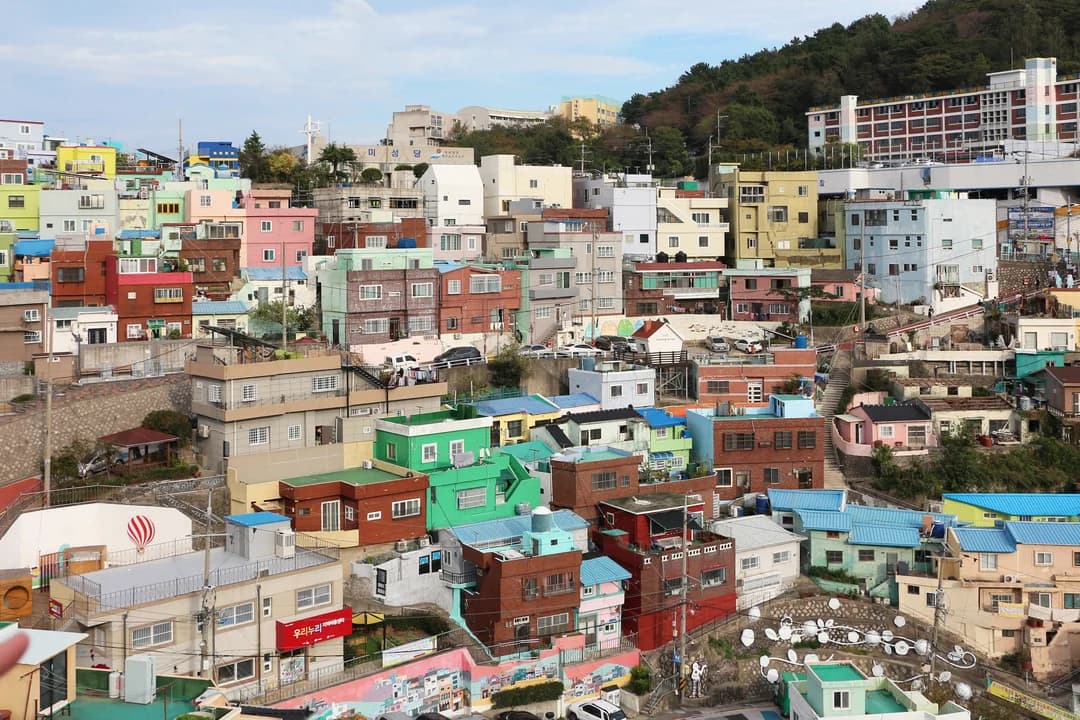
Gamcheon Culture Village is a hillside neighborhood of pastel houses in Saha-gu that refugees settled during the Korean War. It became a tourist destination after the 2009 Village Art Project, when students, artists and residents decorated the alleys, and it is nicknamed the Machu Picchu of Korea. Entry is free; the village is open every day, 09:00 to 18:00 from March to October and 09:00 to 17:00 from November to February (as of 2026-10-11).
To get there, take Line 1 to Goejeong Station, Exit 6, and change to village bus Saha 1 or Saha 1-1; or Toseong Station, Exit 6, village bus Saha 1-1, Seo-gu 2 or Seo-gu 2-2. Get off at Gamjeong Elementary School and walk about 5 minutes. A stamp map from the village information center guides you to the shops and art spots, and hanbok rental is offered; the Little Prince and desert fox photo spot often has a queue.
This is a residential area, so keep quiet and clean, and do not fly drones. Wear comfortable shoes for the stairs. The village has accessible parking and an accessible toilet, though the slopes are steep.
Yeongdo: Taejongdae, Huinnyeoul and the old bridge
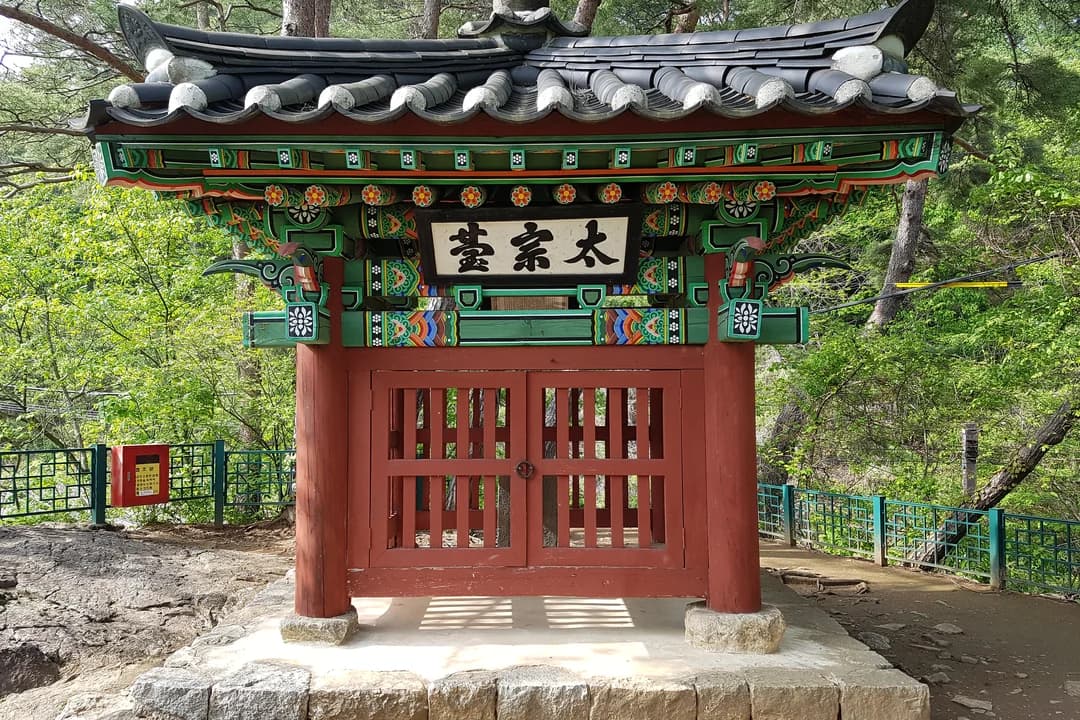
Taejongdae Park is a cliff park at the southern tip of Yeongdo island, named after King Taejong Muyeol of Silla, who is said to have practiced archery here. The recreation area is free and open daily 04:00 to 24:00 from March to October and 05:00 to 24:00 from November to February. Many visitors ride the Danubi Train around the loop road (ticket window 09:00 to 17:30, a train about every 20 minutes); it runs 09:20 to 20:00 from June to August and 09:20 to 18:00 from October to April, and does not run on Mondays (as of 2026-10-11).
The observatory, the first stop on the train, shows Oryukdo and, on a clear day, Tsushima island. Just below it, the Yeongdo Lighthouse has not been dark since 1906. Taejongsa temple hosts a hydrangea festival between late June and early July. From Busan Station Exit 7 (Line 1) take bus 17, 88 or 101 to the Taejongdae stop. The park has ramps, wheelchair rental and accessible toilets.
Huinnyeoul Culture Village clings to the cliff above the Jeoryeong coastal trail. It was a refugee settlement; in December 2011 the old houses were renovated into an art village of 14 alleys with cafes, workshops and independent bookshops. The wall of Jinwoo's house from the film 'The Attorney' is the usual first photo. It is free; take bus 7, 71 or 508 from Nampo Station Exit 6 and get off at Baengnyeonsa Temple. Residents live here, so keep your voice down.
The Yeongdo Bridge, 4 minutes on foot from Nampo Station Exit 6 or 8, opened in 1934 and was where separated families swore to meet again. The lifting ceremony takes place for 15 minutes at 14:00 every Saturday (as of 2026-10-11). The Korea National Maritime Museum is free (except the 4D theater and special exhibitions), open Tuesday to Friday 09:00 to 18:00, Saturday until 19:00 (21:00 from May to August) and Sunday until 19:00, closed on Mondays (as of 2026-10-11).
Songdo Beach and the Marine Cable Car
Songdo Beach, opened in 1913, is the first public beach in Korea. After decades of decline it was restored, and it now receives more than five million visitors a year. The beach area is open 06:00 to 23:00 and free; from Jagalchi Station Exit 2 (Line 1) take bus 96, 26, 30, 7 or 71 to Songdo Beach, then walk 3 minutes (as of 2026-10-11).
The Songdo Cloud Trails skywalk and the Songdo Marine Cable Car share the shore. The cable car runs 09:00 to 21:00 on the day we checked, with ticket sales stopping 30 minutes before closing, and it can stop in bad weather. Round-trip fares are ₩19,000 for adults and ₩14,000 for children in a standard cabin, or ₩24,000 and ₩18,000 in a glass-floor crystal cabin; one-way tickets are ₩15,000 and ₩12,000 (standard) or ₩19,000 and ₩15,000 (crystal). A weekday unlimited day pass is ₩35,000 for adults (as of 2026-10-11). Children are aged 36 months to 12; adults are 13 and over.
A Busan City Tour ticket takes ₩2,000 off the cable car fare (as of 2026-10-11), and both the Green and Orange loops stop here. Nearby, Amnam Park has the Songdo coastal Bollegil walking trail along the cliffs.
Oryukdo, Igidae and the UN Memorial Cemetery
Oryukdo Islets are a group of rocky islands off Nam-gu; they appear as five islands at low tide and six at high tide. The rock formed in volcanic activity about 80 million years ago, and the area is part of the Busan National Geopark and a marine sanctuary. The Oryukdo Skywalk, a 35 m cliff walkway with a glass floor, is free and open 09:00 to 18:00 (last entry 17:50; to 19:00 from June to September), closed in rain, snow or strong wind (as of 2026-10-11).
Wear the overshoes provided, and leave umbrellas, walking sticks, parasols and selfie sticks behind; do not jump on the glass. To get there, take Line 2 to Kyungsung Univ.-Pukyong Nat'l Univ. Station, Exit 5, then bus 131, 24 or 27. The Igidae coastal trail along the cliffs, open to the public since 1993 after decades as a military area, leads on from here through dense forest.
The UN Memorial Cemetery in Korea is the only UN cemetery in the world; it began with about 11,000 graves from 21 participating countries and, after identified remains were returned home, now holds 2,300 graves from 11 countries. It is free, open 09:00 to 18:00 from May to September and 09:00 to 17:00 from October to April. The UN Peace Memorial Hall, open Tuesday to Sunday 10:00 to 18:00, offers only a partial tour from 17 October to 31 December because of renovations (as of 2026-10-11). Keep quiet, dress neatly, and do not bring food or pets or step on graves.
Next door, the Busan Museum covers Busan's history from the Paleolithic to modern times. It is free, open 09:00 to 18:00 (last entry 17:00), closed Mondays and 1 January, and 12 minutes on foot from Daeyeon Station Exit 1 on Line 2 (as of 2026-10-11). The museum, the cemetery and the Peace Park together make a good half-day.
Gijang and the east coast: Haedong Yonggungsa and Songjeong
Haedong Yonggungsa is a temple built on the rocks of the Gijang coast, where the mountain meets the sea. The name comes from a monk's dream of the bodhisattva Avalokitesvara rising on a dragon at the shore. It is free and open every day 04:30 to 19:20 (last entry 18:50) (as of 2026-10-11). Enter and leave by the side doors, because the front door is for monks, lower your voice and tidy your shoes.
From Haeundae Station Exit 7 (Line 2) take bus 181, 100 or Haeundae 9; or take the Donghae Line to Osiria Station, Exit 1, and bus 139. The Blue Line of the city tour bus normally serves this route but is suspended (as of 2026-10-11). The coastal trail beside the temple leads to a fisheries science museum.
Songjeong Beach, one of east Busan's three main beaches with Haeundae and Gwangalli, is known for surfing all year, with beginner-friendly shallow water and surf shops that teach from beginner to advanced level. It is a 17-minute walk from Songjeong Station on the Donghae Line. Cheongsapo Port and Mipo Port nearby are fishing harbors, and Dalmaji Road runs back toward Haeundae.
Beomeosa, Geumjeongsan and Dongnae
Beomeosa in Geumjeong-gu is the third-largest temple in the Yeongnam region after Haeinsa and Tongdosa, built in the reign of King Munmu of Silla at the foot of Geumjeongsan mountain. It is free and open daily 08:00 to 17:00 (as of 2026-10-11). Take Line 1 to Beomeosa Station, Exit 5 or 7, and bus 90. Application for a temple stay is possible; observe silence, because it is a place for monks.
Geumjeongsan is the city's most popular mountain, with the longest fortress wall in Korea; a common route starts at Beomeosa, passes the North Gate and Geumsaem Well, and climbs to Godangbong peak. It is free and always open.
Dongnae was the old administrative center of the area. Dongnae Market is about 250 years old and began as the biggest five-day market of the Joseon period; it is open 08:00 to 20:00 and 5 minutes on foot from Suan Station Exit 7 (Line 4) (as of 2026-10-11). Dongnae pajeon, a scallion pancake with seafood, is the local dish. Oncheoncheon Cafe Street is lined with cafes in converted houses and cherry trees; the stream path is 12 minutes on foot from Allak Station on the Donghae Line. The Dongnae hot springs and the Haeundae hot springs are the city's two famous onsen areas.
Seomyeon, Centum City and shopping
Seomyeon, where metro Lines 1 and 2 cross, is Busan's biggest shopping and nightlife area. Seomyeon Market, around 60 years old, has a food alley of noodle soup, old-style fried chicken and pork-and-rice soup. Seomyeon is also the best transport hub for the city.
Department stores include Lotte Department Store (the main store in Gwangbok-ro and a branch in Dongnae), NC Department Store (Seomyeon, Haeundae and Pusan National University branches) and Shinsegae in Centum City; Lotte Duty Free has a downtown Busan store and a store at Gimhae Airport, and Shinsegae Duty Free also has a Busan store. Centum City is also home to KidZania Busan, on the 4th floor of Centum City Mall.
Food: milmyeon, dwaeji gukbap, raw fish and street snacks
Milmyeon (cold wheat noodles) was created during the Korean War, when refugees from the north missed their cold buckwheat noodles but could only get wheat flour provided by US forces. Dwaeji gukbap, pork and rice soup, is said to have come from refugees from Hwanghae province, who made soup of cheap pork cuts. The food alley of Seomyeon Market is one place to find it.
Seafood: for raw fish, go to Jagalchi or the Millak Fresh Fish Center at Gwangalli, where an appetizer of warm abalone porridge usually arrives first. Eomuk (fish cake) is sold everywhere, especially around Jagalchi, Gukje and Kkangtong markets and Busan Station, where a fish-cake shop sits on the 2nd floor beside the ticket office. Ssiat hotteok, a sweet pancake filled with seeds, is a snack at Gukje Market. Daegu-tang (cod soup) and bokguk (pufferfish soup, cooked only by licensed restaurants) are also local.
Street and market food: Bupyeong-dong is known for pig's trotter salad and old-style fried chicken; Dongnae pajeon is the green-onion pancake made with Gijang chives; Haeundae Market sells spicy rice cakes and fritters. Busan also has its own edition of the Michelin Guide. Look out for the Dwaeji Gukbap Grand Fair on 16 to 18 October 2026 (see the festivals section).
Festivals and events (verified dates)
The Busan International Film Festival (BIFF) runs 6 to 15 October 2026, with screenings and events at the Busan Cinema Center in Centum City, the Culture Hall on the 9th floor of Shinsegae Centum City and other venues; open talks on the Cinema Center roof theater run to 13 October, and the outdoor stage greetings to 11 October (as of 2026-10-11).
The city's October Festival Shiwol 2026 list includes (as of 2026-10-11): Starry Sea Busan Night Market on 15 to 18 October; Busan Dwaeji Gukbap Grand Fair and Busan Craft Beer Masters Challenge, both 16 to 18 October; Busan Wellness Festa, 24 to 25 October; Busan Fashion Week and PFB, 29 to 31 October; Taejongdae Beat-On Zombie Race, 31 October; and the Gwangalli M Drone Light Show every Saturday (3, 10, 17, 24, 31 October). Busan Biennale 2026 runs 29 August to 1 November.
The Busan Biennale 2026, with the theme 'Dissident Chorus', shows 46 artists and groups from 22 countries at the Museum of Contemporary Art Busan, Space Oneji and the former Busan Namsung High School; an individual adult ticket (ages 19 to 64) is ₩16,000 (as of 2026-10-11). The Busan Fireworks Festival lights the sky above Gwangalli in November, and the Hwangnyeongsan viewing lounge is one of the best places to watch. Specific fireworks dates are announced each year and this guide is updated when they are confirmed.
Fixed annual events: the Taejongsa hydrangea festival (late June to early July), the Forty Stairs Culture Festival (every September and October) and the cherry blossoms at Oncheoncheon, Dalmaji Road and Namcheon-dong in spring. Next year's film festival dates are announced by the festival organization in the months before.
Where to stay
Haeundae has the main beaches and most of the luxury hotels, with the highest rates in July to August and during the film festival. Suyeong and Gwangalli suit those who want the bridge view and nightlife on Line 2. Seomyeon, where Lines 1 and 2 cross, is the best all-round transit base. Nampo and Busan Station suit KTX arrivals and early starts at Jagalchi and the old downtown.
For a quieter night, Seonamsa temple on Baegyangsan mountain offers a templestay in simple ondol rooms; from Seomyeon Station Exit 9 (Line 2) take bus 17 or 141, then walk about 14 minutes. Beomeosa also takes temple-stay applications. Book early for the film festival, the fireworks weekend and summer weekends.
Accessibility and families
Taejongdae has ramps, wheelchair rental, accessible toilets and parking; the Busan Museum has wheelchair rental, sign-language guides, an elevator and an accessible toilet; Korea National Maritime Museum has wheelchair rental, an elevator and braille guides; the Amisan Observatory has ramps and an elevator, and the Nakdong Estuary Eco Center has an elevator and wheelchair rental (as of 2026-10-11). Gamcheon Culture Village has accessible parking and an accessible toilet, but its slopes are steep.
For families: Busan Aquarium at Haeundae, KidZania Busan at Centum City Mall, the Busan National Science Museum in Gijang and Lotte World Adventure Busan are the main indoor and theme-park options; the Taejongdae Danubi Train and the Songdo cable car work well with small children. The Busan City Tour accepts children from 48 months at the child fare.
Safety, weather and etiquette
Beach and cliff safety: rip currents can occur on Busan beaches, and lifeguards are on duty mainly in the summer season, so swim only where flags and guards are present. Waves and wind can close the Oryukdo Skywalk, the Songdo cable car and the Danubi Train, as noted above. Eulsukdo Eco Park restricts entry to its protected areas and bans cooking, camping, fishing and plant picking.
Etiquette: Gamcheon and Huinnyeoul are residential, so keep quiet and clean and do not use drones; observe silence and neat dress at temples and the UN cemetery; do not take food or pets into the cemetery; at Hwangnyeongsan, do not damage the forest, drink or smoke, and take your trash with you; on beaches carry your rubbish out or use the bins.
3-day itinerary
- Day 1, old downtown: KTX to Busan Station, then Jagalchi Market (open from 05:00; raw fish lunch), Gukje Market (09:00 to 20:00, closed Sunday), Yongdusan Park and Busan Tower (10:00 to 22:00), and an evening at Bupyeong Kkangtong night market (19:30 to midnight). All of it is within walking distance around Nampo Station on Line 1.
- Day 2, west and south: Gamcheon Culture Village from 09:00 (Line 1 to Goejeong Station Exit 6, then village bus Saha 1), lunch near Jagalchi, then Songdo Beach, the Cloud Trails and the Marine Cable Car (09:00 to 21:00). Take Line 2 to Gwangalli for dinner by the bridge and, on a Saturday, the drone show.
- Day 3, east coast: Haedong Yonggungsa early in the morning (open 04:30 to 19:20; bus 181 or 100 from Haeundae Station Exit 7), then Haeundae Beach, Dongbaekseom and Dalmaji Road at sunset, and dinner at Haeundae Market (open until 22:00).
5-day itinerary
- Day 1, old downtown: Jagalchi, Gukje and Kkangtong markets, Yongdusan Park and the Busan Modern History Museum (free, Tuesday to Sunday 09:00 to 18:00; open until 20:00 on the last Wednesday of the month).
- Day 2, Gamcheon and Songdo: Gamcheon Culture Village from 09:00, the Provisional Capital Memorial Hall in Seo-gu (free, closed Mondays), then Songdo Beach and the Marine Cable Car.
- Day 3, Yeongdo: Huinnyeoul Culture Village and the Jeoryeong coastal trail in the morning, Taejongdae by Danubi Train (not on Mondays) at midday, then the National Maritime Museum (closed Mondays) in the afternoon. On a Saturday, cross the Yeongdo Bridge at 14:00 for the lifting ceremony.
- Day 4, Nam-gu and Suyeong: the Busan Museum and the UN Memorial Cemetery in the morning (Daeyeon Station, Line 2), the Oryukdo Skywalk (09:00 to 18:00) and the Igidae trail in the afternoon, and Gwangalli at night.
- Day 5, Haeundae and Gijang: Haedong Yonggungsa early (04:30 to 19:20), Songjeong Beach if you want to surf, then Haeundae Beach, Dongbaekseom and Dalmaji Road. For a temple-and-hot-spring day instead, replace Gijang with Beomeosa (08:00 to 17:00), Dongnae Market and Oncheoncheon, and finish in Seomyeon.
Tips
Mondays are the hardest day: the Busan Museum, Modern History Museum, Maritime Museum, Provisional Capital Memorial Hall, Museum of Movies and the Taejongdae Danubi Train are all closed, and the city tour bus does not run on Mondays and Tuesdays. Plan beaches, markets and temples for Mondays (as of 2026-10-11).
Phone help: the Korea Travel Helpline 1330 answers in several languages, and Busan's own travel hotline, 051-120, takes calls on weekdays from 08:30 to 18:30 (as of 2026-10-11). Currency exchange is available at the airport and the ferry terminal, so you can change cash on arrival.
Use the metro as the backbone and buses only where the metro does not go. Carry a rechargeable transit card, wear shoes with grip for the hillside villages and stairs, and keep one indoor stop in reserve for each day in case of rain or wind.
Sources and last update
Last updated: 11 October 2026. Figures are as of the date shown.
Source: Visit Busan · Korea Tourism Organization · Busan Transportation Corporation · Busan City Tour · Songdo Marine Cable Car · Visit Busan Pass · Busan International Film Festival · Busan Biennale 2026 · Gwangalli M Drone Light Show · Wikipedia · Wikivoyage · Checked 11 Oct 2026
Written by HOLIDAY in its own words from official public information. This is not an official publication of the Korea Tourism Organization or any government body.
HOLIDAY refreshes this article regularly as fares, hours and event dates change.


![[Spring] Taean Tulip Festival and Flower Park Day Tour](/_next/image?url=https%3A%2F%2Fadmin.holidaykr.com%2Fapi%2Fadmin%2Fsystem%2Fbasic-settings%2Ffavicon%3Fpath%3D%252Fuploads%252Fproducts%252Fthumbs%252F750_1731309018_file1.jpg&w=3840&q=75)