Destination briefing
Why travelers stop here
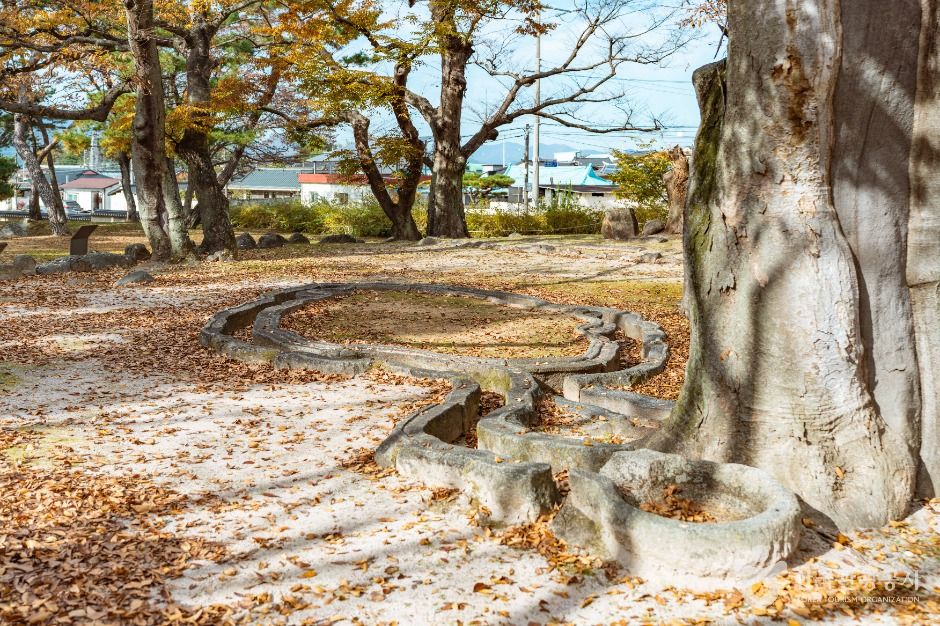
This is a well that holds the legend of the birth of Bak Hyeokgeose, the founder of Silla. Remains include a monument honoring Bak Hyeokgeose, an octagonal building site presumed to be the site of a sacred palace, a well site, a wall site, auxiliary building sites, and drainage channels. In particular, the octagonal building site, with each side measuring 8 meters and surrounded by a square wall, is presumed to be the site of a Silla sacred palace, suggesting that Najeong was a shrine for holding ancestral rites for Bak Hyeokgeose.
According to the "Samguk Sagi" (History of the Three Kingdoms) and "Samguk Yusa" (Memorabilia of the Three Kingdoms), the following record exists about Najeong. The chiefs of the six villages, who were the leading figures in the founding of Silla, gathered and decided to elect a monarch and establish a capital. As they climbed to a high place, they saw a strange aura near a well called Najeong below Yangsan, where a white horse was kneeling. When they approached, the white horse ascended to the sky, leaving only a large red egg. When they cracked the egg, a baby boy emerged. They found this strange and bathed him in Dongcheon Stream, whereupon his body emitted a radiance, and birds and beasts danced as if in play, causing heaven and earth to shake and the sun and moon to become clear. Because he was born from an egg shaped like a gourd (bak), his surname was Bak, and his name was Hyeokgeose, meaning 'to brighten the world.' In 57 BC, when the child turned 13, he ascended the throne, founded the kingdom, and named it Seorabeol.
OTA-ready stop
Built into inbound routes and day-tour planning.
Local context
경상북도 경주시 탑동 (탑동)700-1
Travel fit
Attraction · Gyeongsangbuk-do



![[Early bird] Elysian Gangchon Ski Tour from Seoul (5 pick-up points)](/_next/image?url=https%3A%2F%2Fadmin.holidaykr.com%2Fapi%2Fadmin%2Fsystem%2Fbasic-settings%2Ffavicon%3Fpath%3D%252Fuploads%252Fproducts%252Fthumbs%252F750_1785201339504_file1.jpg&w=3840&q=75)