Destination briefing
Why travelers stop here
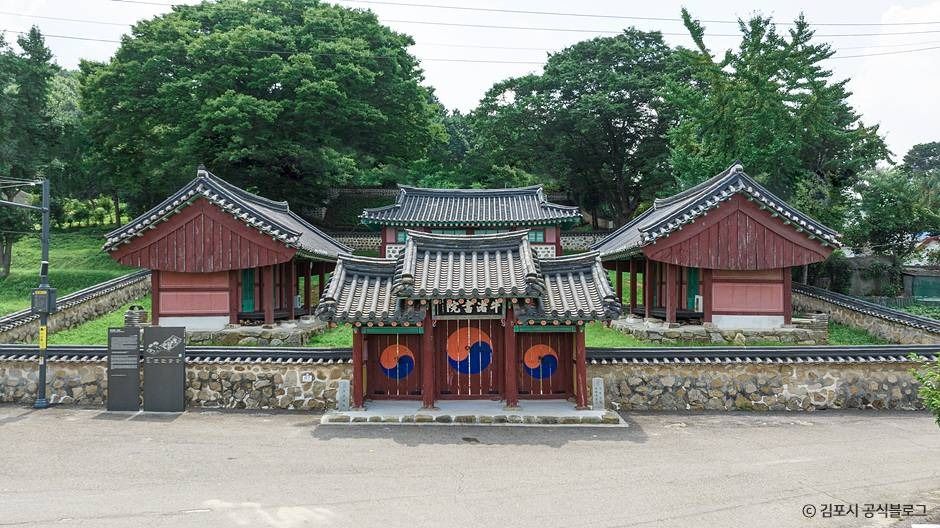
Gimpo Hyanggyo is said to have been first built in 1127, but this is not certain. The hyanggyo was originally located on the hillside where Gimpo Girls' Comprehensive High School now stands, but was moved to Geolpo-ri, Gimpo-eup when a royal tomb was placed there, and then moved again to its current location. The buildings have undergone several repairs since the 1960s, taking on their present appearance. The layout places the educational space—Myeongnyundang (lecture hall) and the East and West Study Halls—in the front, and the ritual space—Daeseongjeon (main shrine) and the East and West Auxiliary Shrines—in the back. There are also a Jaesil (purification hall) and the outer and inner gates (Oesammun and Naesammun). Daeseongjeon measures 3 kan (bays) in front and 3 kan on the sides, with a gable roof shaped like the Chinese character 人 (person). Myeongnyundang measures 5 kan in front and 2 kan on the sides, and unlike Daeseongjeon, it has a hip-and-gable roof shaped like the character 八 (eight). Inside Myeongnyundang, unlike the common practice of making one kan each into rooms on the left and right, Gimpo Hyanggyo has the entire space as a single kan. This well represents the small-scale hyanggyo format of the late Joseon period, consisting only of Daeseongjeon and Myeongnyundang.
(Source: National Heritage Administration)
OTA-ready stop
Built into inbound routes and day-tour planning.
Local context
경기도 김포시 북변중로25번길 38 (북변동)
Travel fit
Attraction · Gyeonggi-do
![Gimpo Jangneung (Tomb of King Wonjong and Queen Inheon) [UNESCO World Heritage]](http://tong.visitkorea.or.kr/cms/resource/50/3361650_image2_1.jpg)
![[Early bird] Elysian Gangchon Ski Tour from Seoul (5 pick-up points)](/_next/image?url=https%3A%2F%2Fadmin.holidaykr.com%2Fapi%2Fadmin%2Fsystem%2Fbasic-settings%2Ffavicon%3Fpath%3D%252Fuploads%252Fproducts%252Fthumbs%252F750_1785201339504_file1.jpg&w=3840&q=75)