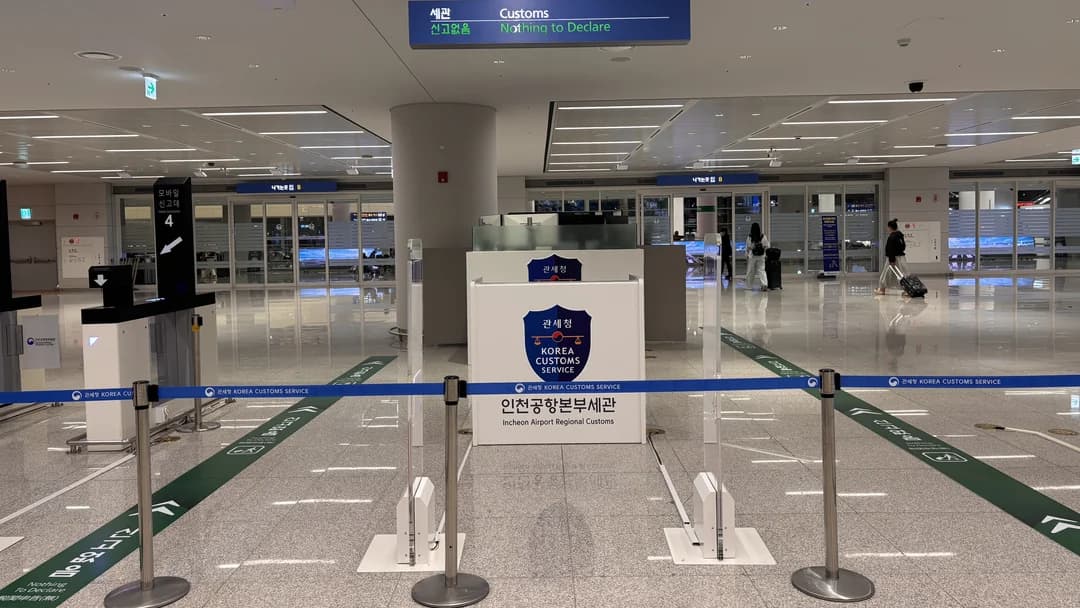
Visa-free entry and stay lengths by nationality, Jeju and transit special rules, short-term visa types, how to apply, how to extend a stay, fees, registration, overstaying and the immigration help line. Figures are as of 2026-10-11.
At a glance (as of 2026-10-11)
Whether you need a visa depends on your nationality, the purpose of the trip and how long you stay. Short-term visits are stays of less than 90 days (as of 2026-10-11).
There are two ways to arrive for tourism: visa-free (status B-1 or B-2) if your nationality qualifies, or a short-term visa (status C-3) issued before you travel if it does not.
Visa-free travelers may still need a K-ETA authorization (or be on the 2026 temporary exemption list) and must file the e-Arrival Card unless they hold a K-ETA. The Entry guide explains both.
Visa-free does not mean you may work. Employment or any profit-making activity needs a visa that matches that activity.
Visa-free stays by nationality (as published)
The published visa-free list names 45 designated countries and territories and is dated 2023-01-02 (as of 2026-10-11). Stay lengths are shown for only some of them; the rest are listed without a number.
90 days is listed for Japan, Taiwan, Hong Kong, Macao, the United States and Australia. Canada is listed with 6 months (as of 2026-10-11).
90 days is also listed for Kuwait, Ecuador, Serbia, Slovenia and Croatia (as of 2026-10-11).
Listed without a stay number, Asia: Brunei, Saudi Arabia, Oman, Bahrain. Americas: Guyana, Argentina, Paraguay, Honduras, and Guam. Europe: Monaco, the Vatican, Bosnia and Herzegovina, Albania, Cyprus, San Marino, Montenegro, Andorra (as of 2026-10-11).
Listed without a stay number, Oceania: Nauru, New Caledonia, Micronesia, Samoa, Solomon Islands, Kiribati, Fiji, Marshall Islands, Palau, Tuvalu, Tonga. Africa: South Africa, Seychelles, Mauritius, Eswatini (listed as Swaziland), Botswana (as of 2026-10-11).
Separately, nationals of countries that have a visa-exemption agreement with Korea may visit for tourism or temporary purposes without a visa, with the length set by that agreement. That table is separate from the 45 above.
Mainland China is not on the 45-country list. The published rules list special group schemes for Chinese nationals (Jeju transfer groups 15 days, groups with a Japanese group visa 15 days, school field trips 30 days); otherwise a visa is the normal route (as of 2026-10-11).
Jeju special entry and transit rules (as of 2026-10-11)
Jeju Island: nationals of every country except the 23 excluded nationalities can enter Jeju without a visa for tourism or transit, for up to 30 days (status B-2), if they arrive by direct flight or ferry and stay only on Jeju (as of 2026-10-11).
The 23 nationalities not covered by the Jeju and transit schemes: Syria, Sudan, Iran, Cuba, Kosovo, Palestine, Afghanistan, Iraq, Nigeria, Ghana, Yemen, Gambia, Senegal, Bangladesh, Kyrgyzstan, Pakistan, Somalia, Uzbekistan, Nepal, Cameroon, Sri Lanka, Myanmar, Egypt (as of 2026-10-11).
Third-country transit: travelers who normally need a visa may enter as tourist/transit (B-2) for up to 30 days if they hold a visa or residence for the US, Canada, Australia, New Zealand or one of 32 listed European countries and are passing through Korea to or from there (as of 2026-10-11).
Conditions for that transit rule include a confirmed onward flight within 30 days, no more than 3 days in the transit country, no Korean visa refusal in the past 1 year, no Korean entry refusal in the past 3 years, and no fine over 5 million won (as of 2026-10-11).
Airport transfer tourism: foreigners changing planes at Incheon who join the transit tour program can enter as B-2 for up to 3 days if their onward ticket leaves within 72 hours and they stay in the capital region (as of 2026-10-11).
Short-term visa types (as published)
The short-term category covers stays of less than 90 days. Visa-free entry shows up as status B-1 (visa exempted) and B-2 (tourist or transit; B-2-1 general and B-2-2 Jeju) (as of 2026-10-11).
Short-term visas are status C-3: C-3-1 short-term general, C-3-2 group tourist, C-3-4 business visitor (general) and C-3-9 ordinary tourist (as of 2026-10-11).
C-3 covers short stays for travel or transit, medical treatment, visiting relatives, major sports events, conferences, cultural or artistic events, religious ceremonies and similar non-profit purposes (as of 2026-10-11).
For a C-3 stay you present a passport, the visa and the arrival declaration. For B-1 and B-2 you present a passport and the arrival declaration (as of 2026-10-11).
Visits for study, work, long-term family reasons or stays over 90 days belong to the long-term categories (91 days or more), which have their own visa types and requirements.
Applying for a visa, step by step
- Decide the category from your purpose and the length of stay: tourism or a short visit of under 90 days points to C-3; a stay of 91 days or more points to a long-term visa. The Korea Visa Portal filters its visa types by exactly these two questions.
- Gather the documents: a valid passport with blank pages, a photo, proof of the purpose of your trip, and proof of lodging and funds. The exact list depends on the visa type and your nationality.
- File the application online where the visa type allows it, or in person at the Korean embassy or consulate in the country where you live. Pay only the fee quoted at that office; it differs by nationality and visa type, so no single figure is given here.
- Processing time varies and can be longer in busy seasons. Apply early, and do not buy non-refundable flights or hotels until the visa is approved.
- When the visa is issued, check that your name, passport number, visa type and validity dates are correct. Entry must happen before the visa expires.
- Keep the approval and copies of all documents, and carry them with you when you travel. A visa is permission to arrive; the immigration officer still makes the final entry decision at the counter.
What officers check and what a visitor may do
Entry requires a valid passport; people with an expired passport are not allowed in. If you need a visa, it must be valid, you must enter before it expires, and the purpose of your trip must match the visa type.
Certain categories of people are barred from entry, for example international terrorists and people who stayed illegally before. The officer can refuse entry if the purpose does not fit the visa.
On a short visit you may sightsee, visit relatives, attend events and similar non-profit activities. Employment or other profit-making activity needs a Korean visa that allows it.
Foreign visitors may do what their status allows and stay for the period granted, but may not take part in political activities unless the law specifically allows it. Activities outside your status need permission first, with a fee of 120,000 won (as of 2026-10-11).
Extending your stay (as of 2026-10-11)
- Decide before your permitted stay ends: an extension of sojourn is applied for from 4 months before the current expiry date up to the expiry date itself (as of 2026-10-11).
- Apply in person, or through an agent, at the immigration office that has jurisdiction over your address in Korea. Documents depend on your status of stay.
- Bring your passport, the application form, the documents for your status and the fee. The extension fee is 60,000 won, or 30,000 won for F-2 and F-6 holders (as of 2026-10-11).
- Most immigration services start with a visit reservation made online in advance, so book early rather than turning up on the last day. Whether an extension is granted is decided by the immigration office.
- If you apply after the expiry date, you pay a penalty under Article 25 of the Immigration Act. The amount is not stated in the stay guide, which is a good reason to apply early.
Other immigration fees (as of 2026-10-11)
Change of status of stay: 100,000 won. Granting a status of stay: 80,000 won (40,000 for F-6) (as of 2026-10-11).
Re-entry permit: 30,000 won for a single entry and 50,000 won for multiple entries. Change or addition of an employer: 120,000 won (as of 2026-10-11).
Issuing or reissuing a residence (registration) card: 35,000 won, payable in cash only. Some nationalities and reporting duties are fee-exempt (as of 2026-10-11).
Tourists on a short visit normally pay none of these, except for an extension. Costs apply only when you extend, change status or take another action that needs a permit.
Registration, reporting and overstaying
A stay of 91 days or more is a long-term stay: foreign residents must register as foreign residents, or file a domestic residence report, within 90 days of arrival (as of 2026-10-11).
Registered foreigners must report changes such as name, nationality, passport number or validity, or school or employer details to the local immigration office within 15 days of the change. Late reports are treated as a violation of the Immigration Act and can be fined (as of 2026-10-11).
Overstaying: people who stayed beyond the permitted period may leave only after completing the prescribed procedure at the immigration office, may be fined, and in serious cases can be deported without their consent. The guide does not publish penalty amounts.
When leaving, have your passport and boarding pass ready for the departure inspection. If you are leaving Korea for good, return your foreign registration card there; not returning it can bring a negligence fine.
If you plan to leave and return within your granted stay, a re-entry permit is needed (30,000 won single, 50,000 won multiple; as of 2026-10-11), except for nationalities exempt from the permit.
The 1345 immigration contact center (as of 2026-10-11)
The Immigration Contact Center answers on 1345 from inside Korea, Monday to Friday, 09:00 to 22:00, except public holidays (as of 2026-10-11). Normal call charges apply.
From abroad, dial +82-2-1345, or +82-2-6908-1345 and 6908-1346 (as of 2026-10-11).
It handles questions about visas, status of stay, extensions and registration. Have your passport number, nationality and status of stay ready, and say your language at the start of the call.
Note that the K-ETA center does not take phone calls; K-ETA questions go through the inquiry form inside the application. For danger to life, never wait for office hours: call 112 or 119 (see the Emergency guide).
Do
- Do work out your route early: visa-free list, agreement list, Jeju or transit scheme, or a short-term visa. Start with your nationality.
- Do check that the name and passport details on every form match your passport exactly, and that the passport has enough validity and blank pages.
- Do keep your return ticket, lodging address and phone number ready, and carry your passport in Korea.
- Do book your immigration office visit early if you need an extension, and apply well before the expiry date.
Avoid
- Do not work, or take paid work, on a tourist stay, and do not overstay.
- Do not pay unofficial agents who promise a guaranteed outcome; no one outside the government can guarantee approval.
- Do not arrive with an expired or nearly full passport, and do not assume that being on a visa-free list means no paperwork at all.
- Do not leave an extension to the last day, and do not travel on a visa-free route that does not match your trip, for example a Jeju-only entry that you then use to travel to the mainland.
Quick answers and a note on changing rules
How long can I stay as a tourist? It depends on nationality. Short visits are under 90 days, and the published list shows 90 days for Japan, Taiwan, Hong Kong, Macao, the US and Australia, and 6 months for Canada (as of 2026-10-11).
Is a visa-free nationality also exempt from K-ETA? Not automatically. Only the 22 listed countries and territories are exempt during 2026; everyone else who is visa-free needs K-ETA (as of 2026-10-11).
Can I extend a short stay? You can apply from 4 months before expiry up to the expiry date for 60,000 won; the immigration office decides (as of 2026-10-11).
Where do I get help in my language? Say your language to the 1345 center on weekdays, ask the embassy or consulate of your own country for passport and document problems, and in an emergency call 112 or 119 (see the Emergency guide).
Rules, lists and fees change, and the visa-free list used here is the published one dated 2023-01-02. This guide is refreshed regularly and was last updated on 2026-10-11; the immigration officer’s decision at the counter always applies.
Sources and last update
Last updated: 11 October 2026. Figures are as of the date shown.
Source: Korea Visa Portal · HiKorea · Ministry of Justice, K-ETA · Checked 11 Oct 2026
Written by HOLIDAY in its own words from official public information. This is not an official publication of the Korea Tourism Organization or any government body.
HOLIDAY refreshes this article regularly as fares, hours and event dates change.