Korea's winter festivals, December to March: lantern streams, Gangwon ice and snow, Seollal, plum and strawberry events. Dates as of 2026-10-11.
December to January: lantern streams and winter lights
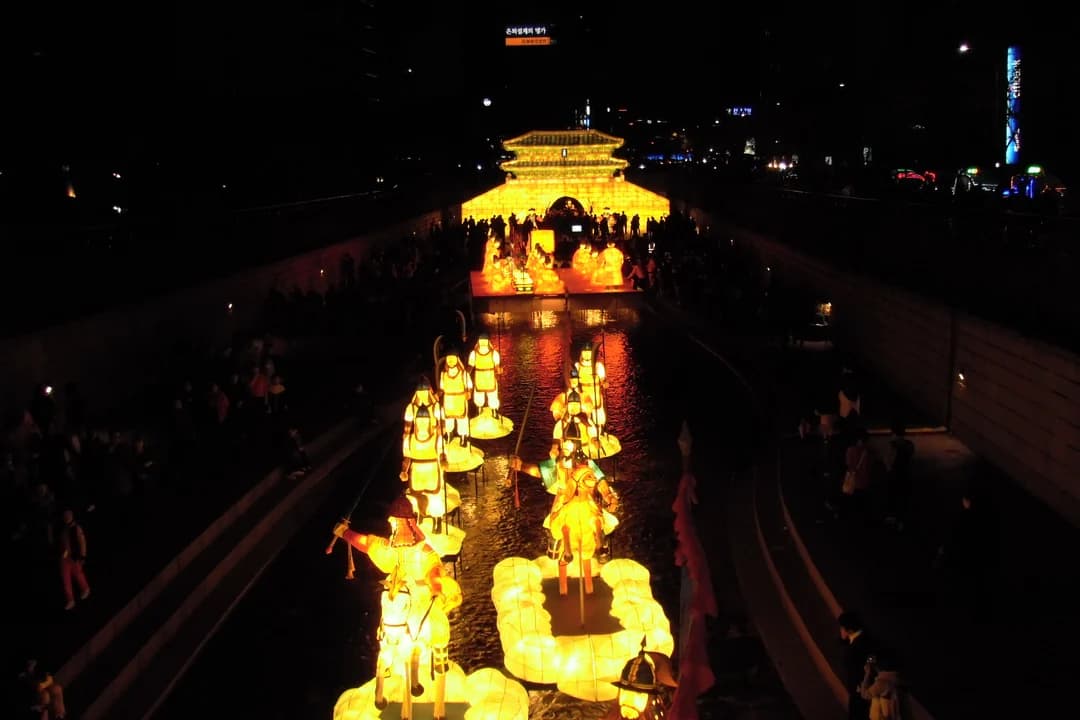
From December the evenings in and around Seoul fill with light: lanterns along the Cheonggyecheon stream, illuminated gardens in the hills of Gapyeong and Pocheon, and Christmas displays at department stores and shopping towers. In mid-winter the beach at Haeundae in Busan hosts a very different ritual, a mass plunge into the cold sea. Most light events switch on at dusk and run late into the evening, so plan to arrive around sunset and dress for cold air.
Seoul Lantern Festival (서울빛초롱축제) · Cheonggyecheon stream, central Seoul (Cheonggye Plaza to Samil Bridge)
When: Recent editions run from mid-December to mid-January. The 2025 edition ran 12 Dec 2025 to 18 Jan 2026 (as of 2026-10-11). The next edition’s dates are added once announced.
Highlights: About 1.1 km of the stream is lit in four themed zones, from hanji-paper and media-art lanterns to gold installations. The 2025 edition floated around a hundred carp lanterns on the water and finished with light projections and a “light aurora” at Samil Bridge (as of 2026-10-11).
Best time & crowds: Evenings only. The 2025 edition opened 18:00 to 22:00 and later extended to 23:00 (as of 2026-10-11). Weekends tend to be very crowded and weekdays calmer; the 2025 edition drew about 2.77 million visitors in its first 20 days (as of 2026-10-11).
Entry: Free to walk along the stream in the 2025 edition (as of 2026-10-11).
From Seoul: The venue is in central Seoul. Take the Subway to Gwanghwamun Station and walk to Cheonggye Plaza at the upper start of the route.
Nearby: Gwanghwamun, Gyeongbokgung, Dongdaemun
Tips: Dress warmly because the stream channel is cold after dark. Allow time for a slow stroll with photo stops. Dates are not fixed far in advance, so book flexible plans for a December or January trip.
Related guide: The Seoul region guide and the Subway guide help with getting around this area.
Garden of Morning Calm Lighting Festival (아침고요수목원 오색별빛정원전) · Sangmyeon, Gapyeong, Gyeonggi
When: Usually from early December to mid-March. The last season ran 5 Dec 2025 to 15 Mar 2026 (as of 2026-10-11). The next season’s dates are added once announced.
Highlights: A botanical garden turned into themed light zones for animals, love and flowers, with illuminated arch tunnels, a glowing horse-and-carriage and a swing in front of a heart of lights. The lights may be switched off in bad weather for safety.
Best time & crowds: During the festival the garden is open 10:00 to 21:00, and until 23:00 on Saturdays; entry closes one hour before closing (as of 2026-10-11). Lights come on around sunset, so evening is the time to be there. Plan two to three hours on site.
Entry: Paid. The garden’s regular admission was adult 11,000 won, youth 8,500 won and child 7,500 won, with discounts for seniors, veterans, people with disabilities and Gapyeong residents (as of 2026-10-11).
From Seoul: Gapyeong lies north-east of Seoul. Take the ITX-Cheongchun train or an express bus to Cheongpyeong, then a taxi or local bus to the garden. Public transport needs a transfer, so a tour or a car can be easier.
Nearby: Nami Island, Petite France, Alpaca World, Gangchon Rail Bike
Tips: Dress very warmly with a hat, gloves and hand warmers; indoor areas are not well heated. Snow is most likely in early to mid-February. Buying tickets in advance saves queuing at the gate. Pick two or three sights at most for one day.
Related guide: The Gyeonggi day-trip guide covers the Gapyeong area, and the Korea weather guide helps with packing.
Herb Island Light Festival (허브아일랜드 불빛동화축제) · Herb Island, Pocheon, Gyeonggi
When: A winter evening season that usually runs from about December to March, but the length varies. The 2024-25 season ran 21 Dec 2024 to 31 Mar 2025, and the following season was reported as 1 Dec 2025 to 28 Feb 2026 (as of 2026-10-11). The next season’s dates are added once announced.
Highlights: An herb garden that is dressed in lights after dark; in winter the island adds more light decorations than in the herb season. The set-up suits families who want an easy evening walk among illuminated displays.
Best time & crowds: After dark, when the displays are lit. Weekends tend to be busier than weekdays.
Entry: Paid. In the 2024-25 season, weekday admission was adult 10,000 won and child or senior 8,000 won, and weekend admission was adult 12,000 won and child or senior 10,000 won (as of 2026-10-11). Prices for the next season are added once announced.
Tips: The season length changes from year to year, so a trip planned for the very start or end of winter should stay flexible. Dress warmly for an evening outdoors.
Related guide: The Gyeonggi day-trip guide helps to plan a Pocheon outing.
Seoul Christmas markets and light displays (서울 크리스마스 마켓·조명) · Jamsil (Lotte World Mall and Tower), Myeongdong, Yeouido, Gwanghwamun, Seoul
When: Roughly November to early January, with the city’s Winter Festa from mid-December to early January. In the 2025 season the Lotte Christmas Market opened on 20 Nov 2025 and a Shinsegae Gangnam Christmas market ran through 30 Dec 2025 (as of 2026-10-11). The 2026-27 programs are usually announced around November and are added once announced.
Highlights: A European-style Christmas market at the Lotte World Tower plaza in Jamsil; a nightly 3D light show on the Shinsegae building facade in Myeongdong; Santa’s House and a gift workshop at The Hyundai Seoul in Yeouido; and the free Winter Festa stalls, tree and light installations around Gwanghwamun and Seoul Plaza.
Best time & crowds: Light displays are for after dark; the Shinsegae facade has run nightly from 17:00 to midnight in the 2025-26 season (as of 2026-10-11). Christmas Eve tends to be the busiest evening of the season, and department-store attractions are busy on weekends.
Entry: Mixed. In 2025 the Lotte market required an online reservation for entry tickets, and the first batch sold out in about 10 minutes; facade shows and the city’s Winter Festa are free (as of 2026-10-11). Amounts for the next season are added once announced.
From Seoul: All sites are inside Seoul and reachable by Subway: Jamsil for the Lotte market, Myeongdong for the Shinsegae facade, Yeouido for The Hyundai Seoul, and Gwanghwamun for the Winter Festa.
Nearby: Lotte World Tower, Myeongdong, Cheonggyecheon, Gwanghwamun
Tips: Reserve the Lotte market the moment tickets open if you want that experience. Christmas Day falls on a public holiday, when banks and offices close but shops and attractions stay open. Expect crowds from Christmas to New Year.
Related guide: The Seoul region guide and the Subway guide cover the districts mentioned here.
Haeundae Polar Bear Festival (해운대 북극곰축제) · Haeundae Beach, Busan
When: A single winter weekend, usually between mid-January and early February. The 39th edition ran 17-18 Jan 2026 at Haeundae Beach (as of 2026-10-11). The 2025 edition was held on 7-9 Feb 2025 at Gwangalli Beach instead, so the venue can change. The next edition’s dates and venue are added once announced.
Highlights: Saturday night has a beach concert. On Sunday morning there is a 1 km open-water swim, a polar-bear sled race and a running race, then an opening ceremony and the main mass plunge into the sea. Side zones include unusual sports challenges and a winter food zone (as of 2026-10-11).
Best time & crowds: Sunday morning is when the main events happen and the crowds are largest; the 2026 plunge drew over 2,000 swimmers and about 12,000 people in total (as of 2026-10-11). Arrive early to find a spot on the sand.
Entry: Mixed. Watching is mostly free; taking the plunge requires registration, and the 2025 registration fee was 30,000 won (as of 2026-10-11).
From Seoul: Busan is in the south-east. Take the KTX or an express bus from Seoul to Busan, then the Busan Subway to the Haeundae area.
Nearby: Haeundae beach promenade, Dongbaek Island, Gwangalli Beach
Tips: You can enjoy the festival without swimming: the concert, games and food zone are open to everyone. Dress warmly, bring a towel and spare clothes if you plan to plunge, and expect the venue to be announced for each edition.
Related guide: The Busan region guide helps with the beach area, and the Korea weather guide helps with winter packing.
January and February: ice and snow in Gangwon
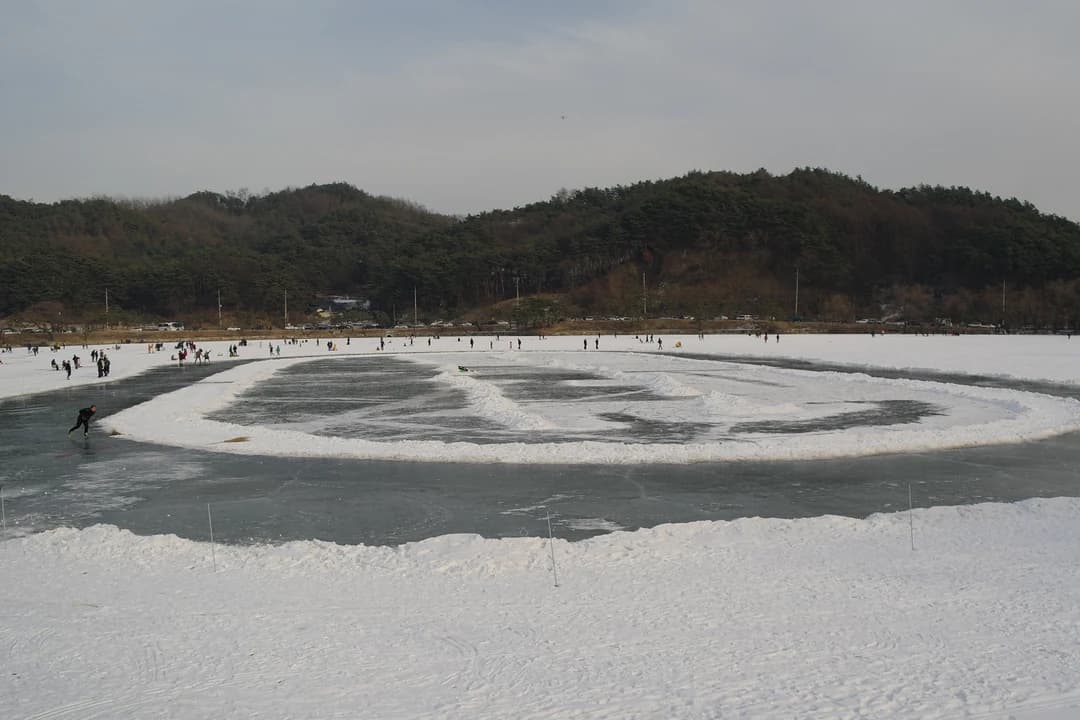
Gangwon Province, north-east of Seoul, turns its frozen rivers and snowy mountain slopes into festival grounds from mid-January to February. Visitors fish through holes in the ice, slide down snow hills, walk frozen gorges and look at giant snow sculptures. The Inje icefish festival on Soyang Lake was canceled in 2024, 2025 and 2026 because the water did not freeze safely (as of 2026-10-11), so do not plan a trip around it. All of these festivals depend on cold weather and are held outdoors, so wear thermal layers, waterproof boots and gloves.
Hwacheon Sancheoneo Ice Festival (화천산천어축제) · Hwacheon, Gangwon (frozen Hwacheoncheon stream; about 90 km north-east of Seoul)
When: Usually mid-January to early February, about three weeks, depending on the ice. The 2026 edition ran 10 Jan to 1 Feb 2026 (as of 2026-10-11). The next edition’s dates are added once announced.
Highlights: Ice fishing for sancheoneo (a mountain trout that lives only in very clean water) through holes in the frozen river, with the catch grilled on site; bare-hand fishing in a pool; a 40 m snow slope and a 60 m ice sled run; an ice bobsleigh tube; ice soccer, curling and skating; an indoor ice-sculpture plaza; and a lantern-lit night street on weekends.
Best time & crowds: Weekends are very crowded and weekdays calmer; the 2025 edition drew about 1.86 million visitors, including about 122,000 from abroad (as of 2026-10-11). Evenings add the lantern street and a night fishing area with zones for foreign visitors.
Entry: Paid; fishing is the main activity and uses rented gear. Amounts for the next edition are added once announced.
From Seoul: Hwacheon is about 90 km north-east of Seoul and about 25 km south of the border with North Korea. Go by intercity bus or car; travel takes a good part of a day round trip.
Nearby: Chuncheon, Paro Lake area, other Gangwon winter festivals
Tips: Wear thermal layers, waterproof boots and gloves; the ice is slippery. Bring some cash for food stalls. Weekday visits are calmer and warmer. Weather can shift the schedule, so a flexible day works best.
Related guide: The Gangwon region guide covers the province, and the Korea weather guide helps with winter packing.
Pyeongchang Trout Festival (평창송어축제) · Jinbu-myeon, Pyeongchang, Gangwon (Odaecheon stream)
When: Usually early January to early February, around one month. The 2026 edition, its 20th, ran 9 Jan to 9 Feb 2026 (as of 2026-10-11). The next edition’s dates are added once announced.
Highlights: Ice fishing, tent fishing in two-person tents and indoor fishing for trout; bare-hand trout catching; snowmobile rafting, an amphibious “Argo” vehicle, spinning snow sleds and ice bikes; and an exhibition on the festival’s story. The 2026 edition also had a mobile-game collaboration (as of 2026-10-11).
Best time & crowds: Weekends tend to be crowded; a weekday in late January usually leaves more room on the ice. Pick a sunny late morning for the warmest fishing.
Entry: Paid, with fishing gear rented on site. Amounts for the next edition are added once announced.
From Seoul: Pyeongchang is in eastern Gangwon. Take a KTX train or an express bus toward Pyeongchang, or drive; plan a full day for the trip.
Nearby: Daegwallyeong, Odaesan and Woljeongsa area, Pyeongchang Olympic venues
Tips: Temperatures can fall far below freezing on the ice, so layer up and bring waterproof gloves. Grilled trout and warm drinks are sold on site. Pairing it with the nearby Daegwallyeong festival makes one winter trip.
Related guide: The Gangwon region guide and the Ski season guide cover the Pyeongchang area in winter.
Daegwallyeong Snow Flower Festival (대관령눈꽃축제) · Daegwallyeong-myeon, Pyeongchang, Gangwon
When: Held in winter, with the timing moving between January and February. The 2026 edition ran 13-22 Feb 2026 (as of 2026-10-11). The next edition will be its 35th, and its dates are added once announced.
Highlights: Snow sledding on the highland slopes, traditional winter games, and a “Snowflake Fairy-tale Winter Kingdom” zone with snow sculptures and play areas for children.
Best time & crowds: Daytime suits sledding and children’s zones. Weekends tend to be busiest. A notice for the final day of the 2026 edition mentioned an early close, so avoid planning for the last evening (as of 2026-10-11).
Entry: A fee schedule exists, so expect paid activities alongside free areas. Amounts for the next edition are added once announced.
From Seoul: Daegwallyeong is a highland pass in Pyeongchang, in eastern Gangwon. Reach it by express bus or car and plan a full day.
Nearby: Pyeongchang Trout Festival site, Odaesan and Woljeongsa, Daegwallyeong highland ranches
Tips: Highland winds make it feel colder than the forecast, so bring a windproof layer. Rules for bringing pets were posted during the 2026 edition, so expect limits if you bring animals along (as of 2026-10-11).
Related guide: The Gangwon region guide and the Ski season guide cover this winter area.
Taebaeksan Snow Festival (태백산눈축제) · Taebaeksan National Park and Taebaek city, Gangwon
When: Usually late January to early February, about nine or ten days. The 33rd edition ran 31 Jan to 8 Feb 2026 (as of 2026-10-11). The next edition’s dates are added once announced.
Highlights: Large snow sculptures by Korean and international artists, a snow-sledding hill, an outdoor skating rink, snow-flower trekking on the mountain, and winter outdoor contests such as a snow-climbing competition (as of 2026-10-11).
Best time & crowds: Daytime shows the sculptures best, and weekends tend to be busiest. High-altitude paths can be icy, so start walks in good light.
From Seoul: Taebaek is in the mountains of south-eastern Gangwon, a long trip from Seoul. Go by train or express bus and plan a full day or an overnight stay.
Nearby: Taebaeksan National Park, Hwangji Pond
Tips: Bring crampons or grippy boots if you walk higher up, and a thick windproof coat. Mountain weather changes fast in winter.
Related guide: The Gangwon region guide covers the province, and the Korea weather guide helps with packing.
Cheorwon Hantangang Ice Trekking Festival (철원 한탄강 얼음트레킹) · Hantan River gorge, Cheorwon, Gangwon
When: Usually mid-January, about nine days. The 2026 edition ran 17-25 Jan 2026 (as of 2026-10-11). The next edition’s dates are added once announced.
Highlights: An 8.5 km ice trek on the frozen Hantan River along the water-top trail, in a river area that is a UNESCO Global Geopark; a sledding hill and snow playground; a food zone; busking under Seungil Bridge; weekend performances; and a bare-torso run on 24 Jan 2026 (as of 2026-10-11).
Best time & crowds: Daytime treks in good light are the safest and most scenic. Weekends tend to be busier because of the performances.
From Seoul: Cheorwon is in northern Gangwon near the border. Reach it by intercity bus or car and expect a long day trip.
Nearby: Hantangang gorge and geopark sites, Seungil Bridge
Tips: Wear boots with good grip. The gorge can be windy, so bring a windproof outer layer. Lodging near Cheorwon is limited, so many visitors would base themselves elsewhere in Gangwon.
Related guide: The Gangwon region guide covers the province, and the Korea weather guide helps with packing.
Seollal and Daeboreum: lunar new year events
Seollal, the Lunar New Year, is the main family holiday of the Korean year, and the first full moon two weeks later, Jeongwol Daeboreum, closes the New Year season with fire, wishes and folk games. Palaces, folk villages and museums in Seoul run cultural programs around both days, and they are an easy way for visitors to see traditions such as kite-making, yut games and moon-house burning. Because the dates follow the lunar calendar, they move every year.
Seollal at Seoul’s palaces (설날 궁궐 행사) · Gyeongbokgung, Changdeokgung, Changgyeonggung, Deoksugung and Jongmyo, Seoul
When: Around Seollal each year. In 2026 Seollal fell on 16-18 Feb, with events starting on the weekend of 14-15 Feb (as of 2026-10-11). The next Seollal’s programs are added once announced.
Highlights: Traditional folk games such as yutnori and jegichagi, hanbok photos on the palace grounds, and special programs; in 2026 Gyeongbokgung held a folk-painting sharing event at Heungnyemun Gate Plaza (as of 2026-10-11).
Best time & crowds: Mornings tend to be calmer before the holiday crowds build. Palace days can be busy for the whole holiday, especially at Gyeongbokgung.
Entry: In 2026, admission to the palaces and Jongmyo was reported free from 14 to 18 Feb, though sources differed on which sites (as of 2026-10-11). Hanbok wearers usually enter free at the palaces.
From Seoul: The palaces are in central Seoul and reachable by Subway.
Nearby: Bukchon Hanok Village, Insadong, the National Folk Museum
Tips: Dress warmly for open courtyards. Closing days differ by palace, so plan your route around the palaces that are open that day. Many shops and department stores close on the holiday itself.
Related guide: The Seoul region guide and the Korea culture guide help to plan a palace day.
Seollal at Namsangol Hanok Village and the Korean Folk Village (남산골한옥마을·한국민속촌) · Namsangol Hanok Village (Jung-gu, Seoul) and Korean Folk Village (Yongin, Gyeonggi)
When: Around Seollal each year. Both sites were open for Seollal in 2026, which fell on 16-18 Feb (as of 2026-10-11). The next Seollal’s programs are added once announced.
Highlights: Namsangol offers hands-on kite, spinning-top and mask making, yut-nori, rice cake and demonstrations of ancestral rites in its restored hanok. The Korean Folk Village adds face painting, kite flying, rice-cake pounding, winter sledding and horse shows.
Best time & crowds: Namsangol is free and tends to fill up early for paid hands-on activities, so go soon after opening. The Folk Village is better with a full day.
Entry: Namsangol was reported as free, open about 11:00 to 17:00, with some paid hands-on activities. The Korean Folk Village was reported at 20,000 won, open about 09:30 to 17:30 (as of 2026-10-11).
From Seoul: Namsangol is in central Seoul and reachable by Subway. The Korean Folk Village is in Yongin, south of Seoul; a shuttle runs from Suwon Station.
Nearby: Namsan Seoul Tower, Myeongdong, Hwaseong Fortress in Suwon
Tips: Dress warmly because most activities are outdoors. Join the paid workshops early, since they fill up. The Korean Folk Village is in Gyeonggi, so allow travel time on top of the visit.
Related guide: The Seoul region guide and the Gyeonggi day-trip guide cover both areas.
Jeongwol Daeboreum, the first full moon (정월대보름) · National Folk Museum and neighborhood festivals in Seoul; beach events in Busan
When: On the 15th day of the first lunar month, about two weeks after Seollal. In 2026 it fell on 3 Mar, with Seoul events on 28 Feb and 2 Mar (as of 2026-10-11). The next one falls around 21 Feb 2027 by calendar calculation, and its events are added once announced (as of 2026-10-11).
Highlights: At the National Folk Museum: wish papers hung on a straw rope around a “moon house”, protective kite making, straw effigies, and a ground-treading ritual with farmers’ music in the front yard. In Yangcheon, Seoul, the neighborhood festival had a drum-and-gong parade, folk games, a 10 m moon-house burning and fireworks over the stream. Busan holds moon-house burnings on Haeundae and Gwangalli beaches (as of 2026-10-11).
Best time & crowds: Late afternoon into evening is the time to be there, because the burnings happen after dark and the best views are of the rising moon. Neighborhood festivals tend to be local and relaxed.
Entry: Free for the events described.
From Seoul: The National Folk Museum is in central Seoul next to Gyeongbokgung; reach it by Subway. Busan needs an express train or bus from Seoul.
Nearby: Gyeongbokgung, Bukchon, Samcheong-dong
Tips: Dress warmly for an evening outdoors. Burnings happen in a controlled area, so watch from the marked spectator zones and keep clear of sparks. Details differ by neighborhood, so choose one event and arrive early.
Related guide: The Korea culture guide explains the traditions behind these customs.
Seollal in practice: Seollal 2027 falls on Sunday 7 Feb 2027, and the public holiday block runs from Saturday 6 Feb to Tuesday 9 Feb 2027, with Tuesday as the substitute holiday (as of 2026-10-11). Expect many Koreans to travel, so intercity trains and buses sell out well in advance. Many department stores, marts and restaurants close on Seollal day itself, while palaces and many tourist sites stay open and the Subway and buses run as usual. The National Folk Museum is closed on Seollal day but open the days around it.
Late winter to March: plum, cornelian cherry, strawberry
As winter ends, the south of the country starts to flower: plum blossoms along the Seomjin River, yellow cornelian-cherry blossoms at the foot of Jirisan, and strawberry season in the central region. The sea path of Jindo appears in spring too, and Seoul fills with sport and style events. Bloom dates follow the weather, so festival dates move from year to year; the 2026 dates below are given as a guide to the usual timing (as of 2026-10-11).
Gwangyang Maehwa (Plum Blossom) Festival (광양매화축제) · Maehwa Village, Daap-myeon, Gwangyang, South Jeolla (Seomjin River)
When: Usually early to mid March, about ten days, following the bloom. The 2026 edition ran 13-22 Mar 2026; earlier editions ran 10-19 Mar 2023 and 8-17 Mar 2024 (as of 2026-10-11). The next edition’s dates are added once announced.
Highlights: Walks beneath white plum blossoms on the village’s plum road, local organic plum products to taste and buy, dishes made with green plums, and nearby farm programs where visitors make plum foods or dye with plums. Bracken and plum picking are also offered in the village.
Best time & crowds: The village is open from 06:00 to 19:00 in the 2026 listing, so morning light is quiet and gentle (as of 2026-10-11). Peak bloom weekends tend to be the most crowded.
Entry: Paid. In 2026 admission was 6,000 won for adults and 5,000 won for teenagers, refunded in full as a voucher for local businesses (as of 2026-10-11).
From Seoul: Gwangyang is in the far south-west. Take the KTX or an intercity bus toward Gwangyang or Hadong, then a local bus to Seomjin Maehwa village. It is a long trip, so plan a full day or an overnight stay.
Nearby: Gurye Sansuyu village, Hadong, Seomjin River scenery
Tips: Spring mornings in the south can still be cool, so bring a light jacket. Because the ticket is returned as a voucher, plan to spend it on plum products in the village. The festival has been canceled before (2020), so weather and events can affect plans.
Related guide: The Intercity trains & buses guide helps with the long trip south.
Gurye Sansuyu Flower Festival (구례산수유꽃축제) · Jirisan hot spring area, Sandong-myeon, Gurye, South Jeolla
When: Usually mid to late March, about nine days. The 27th edition ran 14-22 Mar 2026 (as of 2026-10-11). The next edition’s dates are added once announced.
Highlights: Yellow cornelian-cherry (sansuyu) blossoms on the hillsides at the foot of Jirisan, an exhibition of products made from the fruit, traditional music and dance, hands-on programs, fireworks, sansuyu tea tasting and a fruit-peeling contest. A walking route links the village paths (as of 2026-10-11).
Best time & crowds: The festival listing runs 09:00 to 18:00 in 2026 (as of 2026-10-11). Weekends at peak bloom tend to be the busiest.
Entry: Free in the 2026 edition (as of 2026-10-11).
From Seoul: Gurye is in the south-west. Take the KTX or an intercity bus toward Gurye, then a local bus or taxi to the Jirisan hot spring area. Plan a full day or an overnight stay.
Nearby: Jirisan National Park, Gwangyang Maehwa village, Gurye’s cherry blossom road which has its own late-March festival
Tips: Pair the festival with the hot springs or a short Jirisan walk. Early spring evenings are cool in the mountains, so bring a layer.
Related guide: The Intercity trains & buses guide helps with the trip south.
Icheon Baeksa Sansuyu Flower Festival (이천 백사 산수유꽃축제) · Baeksa area, Icheon, Gyeonggi
When: Usually late March to early April, following the bloom. The 2026 edition ran 3-5 Apr 2026 (as of 2026-10-11). The next edition’s dates are added once announced.
Highlights: Yellow cornelian-cherry blossoms in the Baeksa village area, a flower viewing close enough to Seoul for a day out. Program details for each edition are added once announced.
Best time & crowds: Mornings and weekdays tend to be calmer; weekends at peak bloom are busier.
From Seoul: Icheon is south-east of Seoul in Gyeonggi. Take an intercity bus or drive; exact local routes are added once confirmed.
Tips: Bloom timing changes with the weather, so stay flexible by a few days. Bring a light jacket for spring mornings.
Related guide: The Gyeonggi day-trip guide helps with day trips from Seoul.
Nonsan Strawberry Festival (논산딸기축제) · Nonsan Citizen Family Park, Nonsan, South Chungcheong
When: Usually late March, around four days. The 2026 edition ran 26-29 Mar 2026 and the 2025 edition ran 27-30 Mar 2025 (as of 2026-10-11). The next edition’s dates are added once announced.
Highlights: Strawberry tasting and buying, strawberry picking, jam making, a longest strawberry rice cake contest, dessert competitions, food stalls, live music and dance, and a foot bath in strawberry-infused water (2025 program, as of 2026-10-11).
Best time & crowds: Weekend afternoons tend to be the busiest; mornings are calmer for picking and tasting.
From Seoul: Nonsan is in South Chungcheong, south of Seoul. Take a train or an intercity bus to Nonsan.
Nearby: Other central-region spring festivals; details are added once confirmed.
Tips: Strawberries are at their sweetest in cool spring weather, so go early in the day. Entry arrangements for each edition are added once announced.
Related guide: The Intercity trains & buses guide helps with the trip from Seoul.
Jindo Sea Parting (Miracle Sea Road) Festival (진도신비의바닷길축제) · Hoedong-ri, Gogun-myeon, Jindo, South Jeolla
When: Held in spring, with the date set by the tides; the local government describes it as April to May, but some editions have run in late March. The 2026 edition was reported for 17-20 Apr 2026, and the 2025 edition ran 29 Mar to 1 Apr 2025, 10:00 to 21:00 (as of 2026-10-11). The next edition’s dates are added once announced.
Highlights: At low tide a sea path about 2.8 km long and 30-40 m wide rises between Hoedong-ri and Modo island and stays open for roughly an hour. Visitors walk across and gather clams, abalone and octopus. Programs include Jindo Arirang, ganggangsullae circle dance, the purification ritual Ssitgimgut, a dawn torch parade, Jindo dog shows, tasting of local red liquor and an evening show (as of 2026-10-11).
Best time & crowds: The sea path is open only for about an hour a day, so be at the shore well before low tide and walk out unhurried but return briskly. The festival draws very large crowds.
Entry: Free in the 2025 edition (as of 2026-10-11).
From Seoul: Jindo is an island at the south-western tip of the country, a very long trip from Seoul. Take a bus to Jindo bus terminal, then a local bus to Hoedong, or drive; plan an overnight stay. Lodging on the island is scarce, so Mokpo on the mainland is a practical base.
Nearby: Mokpo, Nammireuksa Temple in Gangjin, Boseong tea fields
Tips: Wear boots or waterproof shoes, because the exposed seabed is wet and muddy. The path appears only for a short window around low tide, so be at the shore early. Do not confuse this Modo with the Modo island near Incheon when setting your navigation.
Related guide: The Intercity trains & buses guide and the Korea weather guide help with this long trip.
Seoul Marathon (서울마라톤, Dong-A Marathon) · Seoul (start at Gwanghwamun Square, finish at Jamsil Sports Complex)
When: A Sunday in mid-March. The 2026 race was held on 15 Mar 2026 (as of 2026-10-11). The next race’s date and entry opening are added once announced.
Highlights: A marathon and a 10 km race. The marathon runs point to point from Gwanghwamun, the historic center, to Jamsil; the 10 km starts in Jamsil. The course is mostly flat with about 100 m of climbing, with aid stations every 5 km (as of 2026-10-11).
Best time & crowds: Roads along the route were closed from about 05:30 to 13:30 in 2026, which also affects spectators and anyone crossing the city that morning (as of 2026-10-11). Watching near the finish at Jamsil or around Gwanghwamun is the easiest.
Entry: Paid for runners. For overseas runners in 2026 the fee was 100 US dollars for the marathon and 80 US dollars for the 10 km. The marathon required a qualifying time under 5 hours, while the 10 km did not (as of 2026-10-11). International registration opened on 1 July of the year before and was first come, first served.
From Seoul: The start and finish are inside Seoul and reachable by Subway.
Nearby: Gwanghwamun and Gyeongbokgung, Lotte World Tower in Jamsil
Tips: Race kits for overseas entrants were shipped to a home address and bib transfers were not allowed (as of 2026-10-11). Mid-March mornings are cold at the start, so bring throw-away warm layers. Plan transport to Gwanghwamun well before the road closures.
Related guide: The Subway guide helps with reaching the start and finish.
Seoul Fashion Week (서울패션위크) · Dongdaemun Design Plaza (DDP), Seoul
When: Two seasons a year. The 2026 F/W edition ran 3-8 Feb 2026 at DDP, earlier than the March timing of past years, and a spring/summer season followed in early September (as of 2026-10-11). The next edition’s dates are added once announced.
Highlights: Runway shows and presentations by Korean brands, a trade show with overseas buyers, showroom visits in Seongsu and Hannam, and a fashion forum. The 2026 F/W edition had 24 brands, 15 shows and 9 presentations, with the main runway hall seating 750 (as of 2026-10-11).
Best time & crowds: Shows are mostly by invitation, so the outside of DDP is where visitors can see the atmosphere. Livestreams are shown on the DDP outdoor screen.
Entry: Mostly by invitation. Before the 2026 F/W edition a public lottery for show invitations ran for about two weeks in January, and the fashion forum had a public session with advance registration (as of 2026-10-11).
From Seoul: DDP is in central Seoul next to Dongdaemun; reach it by Subway.
Nearby: Dongdaemun market, Seongsu-dong, Hannam-dong
Tips: Because the season dates changed between years, treat this as an event to catch if your trip happens to overlap rather than to plan a trip around. Showroom areas in Seongsu and Hannam are worth walking even outside the event.
Related guide: The Seoul region guide and the Subway guide help to explore Dongdaemun and Seongsu.
Sources and last update
Last updated: 11 October 2026. Figures are as of the date shown.
Source: Korea Tourism Organization · Korea Astronomy and Space Science Institute / Korea Aerospace Administration · Seoul Metropolitan Government · Busan Metropolitan City · Korea Heritage Service · Checked 11 Oct 2026
Written by HOLIDAY in its own words from official public information. This is not an official publication of the Korea Tourism Organization or any government body.
HOLIDAY refreshes this article regularly as fares, hours and event dates change.


![[Early bird] Elysian Gangchon Ski & Snowboard Gugok Ice Wall Tour](/_next/image?url=https%3A%2F%2Fadmin.holidaykr.com%2Fapi%2Fadmin%2Fsystem%2Fbasic-settings%2Ffavicon%3Fpath%3D%252Fuploads%252Fproducts%252Fthumbs%252F750_1791455110103_file1.jpg&w=3840&q=75)